Portée maximale fibre optique : distances, budget optique et guide par débit
Sommaire
La portée maximale d'un câble fibre optique n'est pas une propriété du câble seul — c'est le résultat d'un équilibre entre l'atténuation de la liaison et la sensibilité des équipements actifs. Un même câble OS2 peut porter 1 Gbit/s sur 100 km avec des modules adaptés, ou seulement 10 Gbit/s sur 10 km avec des modules standard. Ce guide explique les principes du budget optique, donne les distances réelles par standard et par débit, et vous aide à calculer la portée de votre propre installation.
Le budget optique : concept fondamental
Le budget optique (ou bilan de liaison) est la marge de puissance disponible entre l'émetteur et le récepteur d'une liaison fibre. Il s'exprime en dB et représente la perte maximale que la liaison peut supporter tout en maintenant un taux d'erreurs acceptable (BER ≤ 10⁻¹²).
Budget optique (dB) = Puissance d'émission (dBm) − Sensibilité du récepteur (dBm) − Marge de garde (dB)
Exemple concret avec un module SFP+ LR 10G standard :
- Puissance d'émission typique : −1 dBm à +3 dBm
- Sensibilité récepteur : −14 dBm
- Marge de garde recommandée : 3 dB (vieillissement, variations thermiques)
- → Budget disponible : (3) − (−14) − 3 = 14 dB
Ce budget de 14 dB doit absorber toutes les pertes de la liaison : atténuation du câble, pertes des connecteurs, pertes des épissures à fusion, et pertes des composants passifs éventuels (coupleurs, splitteurs). La portée maximale s'obtient en divisant le budget disponible par l'atténuation par km du câble :
Distance max (km) = Budget disponible (dB) ÷ Atténuation câble (dB/km) − [Pertes fixes / Atténuation câble]
Pour un câble OS2 avec atténuation de 0,35 dB/km à 1310 nm, 4 connecteurs (4 × 0,5 dB = 2 dB) et 2 épissures (2 × 0,1 dB = 0,2 dB) : distance max ≈ (14 − 2 − 0,2) / 0,35 ≈ 33 km.
Distances par standard IEEE et ITU
| Standard | Débit | Type fibre | Longueur d'onde | Distance max | Module |
|---|---|---|---|---|---|
| 1000BASE-SX | 1 Gbit/s | OM2 / OM3 | 850 nm | 550 m | SFP 1G SX |
| 1000BASE-LX | 1 Gbit/s | OS2 SM | 1310 nm | 10 km | SFP 1G LX |
| 1000BASE-ZX | 1 Gbit/s | OS2 SM | 1550 nm | 80 km | SFP 1G ZX |
| 10GBASE-SR | 10 Gbit/s | OM3 / OM4 | 850 nm | 300 m / 400 m | SFP+ SR |
| 10GBASE-LR | 10 Gbit/s | OS2 SM | 1310 nm | 10 km | SFP+ LR |
| 10GBASE-ER | 10 Gbit/s | OS2 SM | 1550 nm | 40 km | SFP+ ER |
| 10GBASE-ZR | 10 Gbit/s | OS2 SM | 1550 nm | 80 km | SFP+ ZR |
| 25GBASE-SR | 25 Gbit/s | OM4 | 850 nm | 100 m | SFP28 SR |
| 25GBASE-LR | 25 Gbit/s | OS2 SM | 1310 nm | 10 km | SFP28 LR |
| 40GBASE-SR4 | 40 Gbit/s | OM3 / OM4 | 850 nm × 4 | 100 m / 150 m | QSFP+ SR4 |
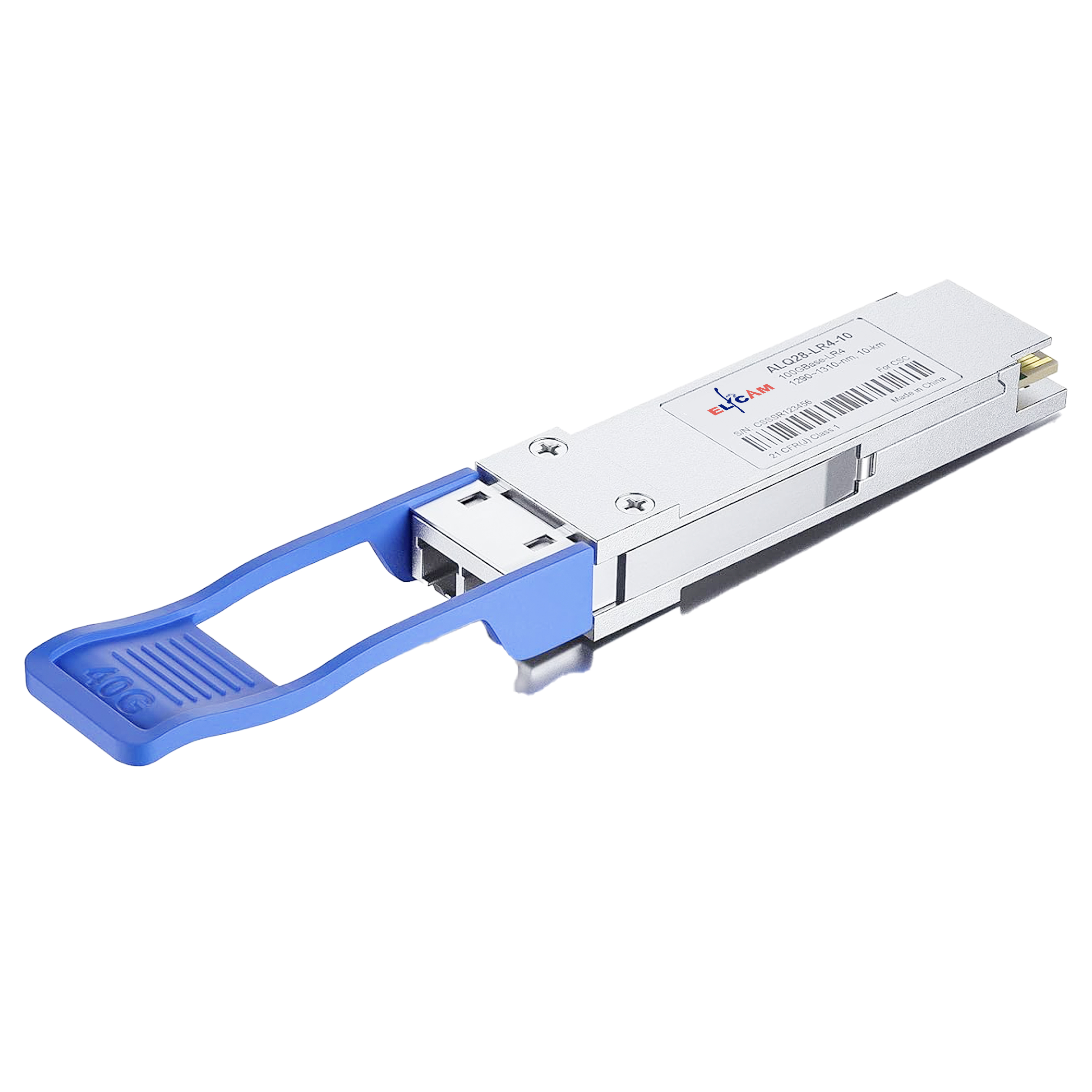
| 40GBASE-LR4 | 40 Gbit/s | OS2 SM | CWDM 4λ | 10 km | QSFP+ LR4 |
| 40GBASE-ER4 | 40 Gbit/s | OS2 SM | CWDM 4λ | 40 km | QSFP+ ER4 |
| 100GBASE-SR4 | 100 Gbit/s | OM4 | 850 nm × 4 | 150 m | QSFP28 SR4 |
| 100GBASE-LR4 | 100 Gbit/s | OS2 SM | CWDM 4λ | 10 km | QSFP28 LR4 |
| GPON (ITU G.984) | 2,5 / 1,25 Gbit/s | OS2 SM | 1490 / 1310 nm | 20 km (classe B+) | SFP GPON OLT |
| XGS-PON (G.9807.1) | 10 Gbit/s symétrique | OS2 SM | 1577 / 1270 nm | 20 km (classe N2) | SFP+ XGS-PON |
Facteurs limitants la portée
Quatre phénomènes physiques plafonnent la distance maximale d'une liaison fibre :
1. Atténuation — c'est le facteur dominant pour les liaisons courtes à moyennes. Chaque kilomètre de fibre absorbe une partie de la puissance lumineuse. À 1310 nm, la silice OS2 présente 0,35 dB/km ; à 1550 nm, seulement 0,20 dB/km (fenêtre de plus faible atténuation). À 850 nm (multimode), l'atténuation est de 3,5 dB/km — soit 17× plus élevée qu'en monomode à 1550 nm.
2. Dispersion chromatique (CD) — les différentes longueurs d'onde composant une impulsion lumineuse voyagent à des vitesses légèrement différentes et arrivent décalées. Ce phénomène élargit les impulsions et crée des erreurs binaires au-delà d'une certaine distance. Les fibres G.652D ont une dispersion nulle autour de 1310 nm (~0 ps/nm·km) et élevée à 1550 nm (~17 ps/nm·km). Pour les systèmes à 100 Gbit/s et au-delà, une compensation de dispersion (DCF ou DSP numérique) est nécessaire.
3. Dispersion modale de polarisation (PMD) — les fibres réelles ne sont pas parfaitement cylindriques : la biréfringence mécanique divise chaque mode en deux composantes de polarisation qui voyagent à des vitesses légèrement différentes. Négligeable pour les débits ≤ 10 Gbit/s, elle devient critique à 40 Gbit/s et au-delà sur les fibres longues. Les fibres modernes G.652D ont une PMD ≤ 0,1 ps/√km.
4. Effets non linéaires — à très haute puissance optique (systèmes DWDM amplifiés), des effets non linéaires apparaissent dans la silice (SPM, XPM, FWM). Ils limitent la puissance injectable et donc la portée sur les liaisons sous-marines et les backbone DWDM longue distance.
Monomode OS2 : de 10 km à plusieurs milliers
La fibre monomode OS2 (G.652D) est la solution universelle pour les distances supérieures à 550 m. Ses atouts : atténuation ultra-faible (0,35 dB/km à 1310 nm, 0,20 dB/km à 1550 nm), absence de dispersion modale, compatibilité avec toutes les technologies de modulation avancées.
Selon le système de transmission employé :
- Liaisons directes sans amplification : 10 Gbit/s sur 10 km (SFP+ LR), 40 km (ER), 80 km (ZR) avec des modules spécialisés
- Liaisons amplifiées (EDFA) : les amplificateurs à fibre dopée erbium compensent les pertes et permettent des distances de 600–1 000 km entre régénérateurs
- Liaisons DWDM : jusqu'à 100 longueurs d'onde multiplexées sur une seule fibre, chacune transportant 100 Gbit/s ou plus, sur des milliers de kilomètres (câbles sous-marins)
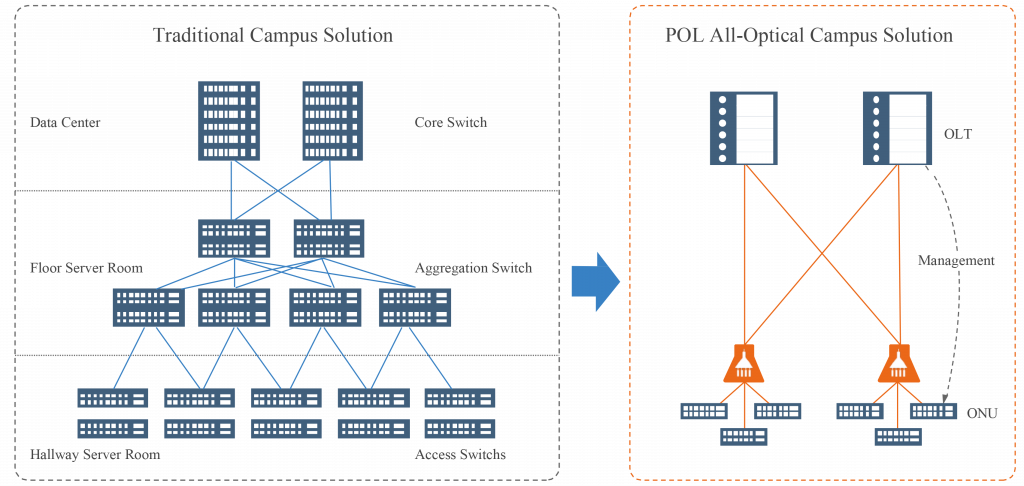
- GPON / XGS-PON : 20 km standard (classe B+/N2), étendu jusqu'à 60 km avec des OLT à budget optique renforcé (PR30)
Astuce : utiliser la fenêtre 1550 nm pour maximiser la portée
À débit égal, un module émettant à 1550 nm (SFP+ ER/ZR) porte 1,5× à 2× plus loin qu'un module à 1310 nm (LR), grâce à l'atténuation plus faible de la silice à cette longueur d'onde. Pour une liaison inter-site entre 15 et 80 km, préférez donc les modules 1550 nm aux modules 1310 nm standard.




Multimode OM3/OM4 : portées courtes mais économiques
La fibre multimode OM3/OM4 est optimisée pour les liaisons courtes à haute densité, typiquement dans les datacenters. Sa limite principale est la dispersion modale : les centaines de modes de propagation s'élargissent mutuellement au fil de la distance, empêchant la transmission à haut débit sur plus de quelques centaines de mètres.
- OM3 : 10 Gbit/s sur 300 m, 40 Gbit/s sur 100 m (MPO-8), 100 Gbit/s sur 100 m (MPO-12)
- OM4 : 10 Gbit/s sur 400 m, 40 Gbit/s sur 150 m, 100 Gbit/s sur 150 m, 400 Gbit/s sur 100 m (MPO-32)
- OM5 : 400 Gbit/s via SWDM4 sur 150 m (4 longueurs d'onde à 850/880/910/940 nm)
L'avantage économique est réel : les modules SFP+ SR (multimode 850 nm VCSEL) coûtent 2 à 3× moins cher que les modules SFP+ LR (monomode 1310 nm laser) à débit équivalent. Pour un datacenter avec des centaines de liaisons serveur-switch de moins de 100 m, l'économie est substantielle.
Ne pas surestimer la portée multimode
Les distances garanties (OM3 : 300 m en 10G) correspondent à des conditions nominales avec des connecteurs propres et une perte d'insertion ≤ 3 dB au total. Avec des connecteurs usés, des courbures serrées ou des épissures de mauvaise qualité, la portée réelle peut être significativement inférieure. Mesurez le budget optique réel avec un OPM (puissancemètre) avant de finaliser une installation multimode critique.
Modules SFP/SFP+/QSFP : choisir par distance
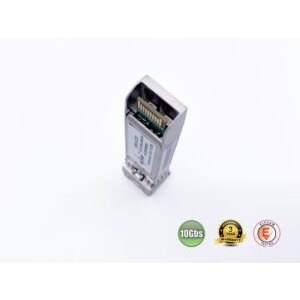
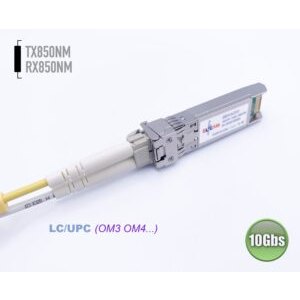
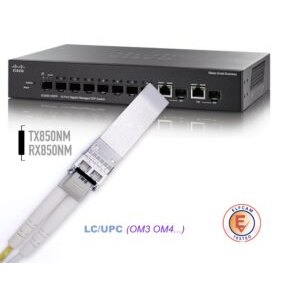
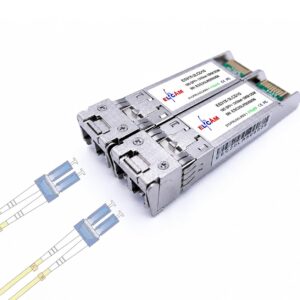
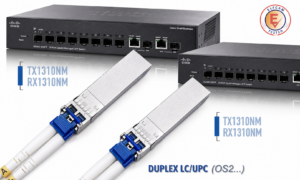
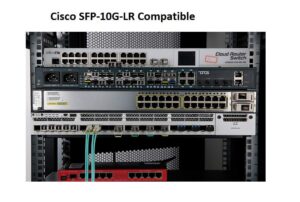
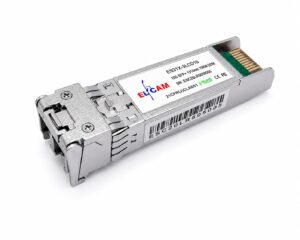
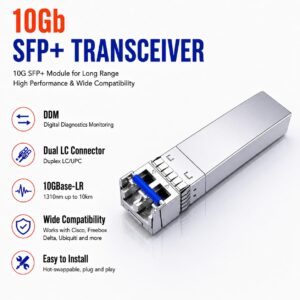
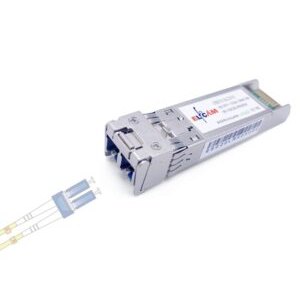
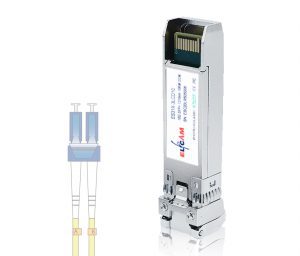
Le module émetteur-récepteur est le composant clé qui détermine la portée. Son choix dépend de trois paramètres : débit cible, type de fibre disponible, distance à couvrir.
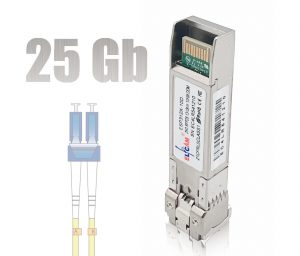
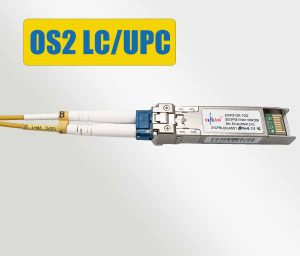
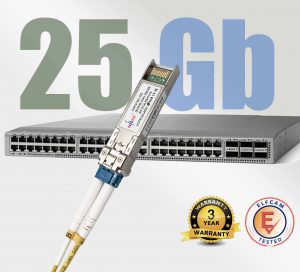
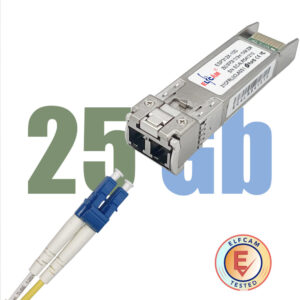
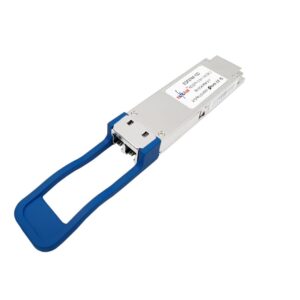
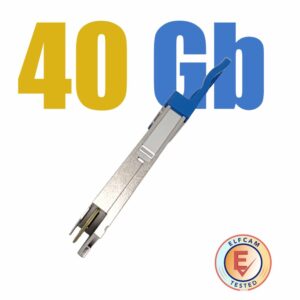
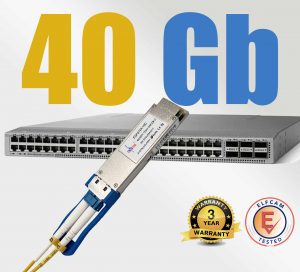
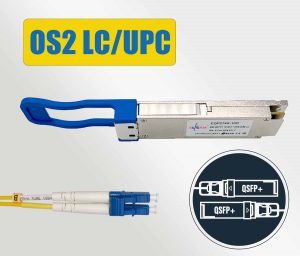
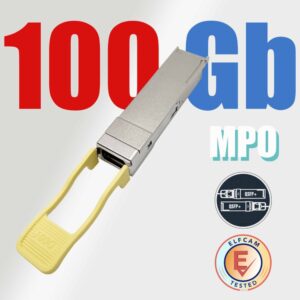
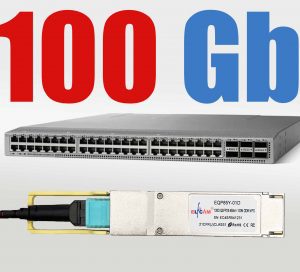
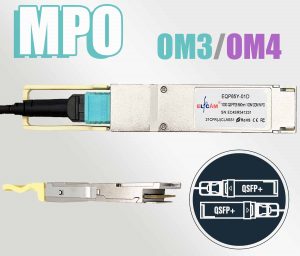

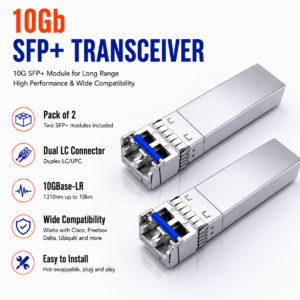
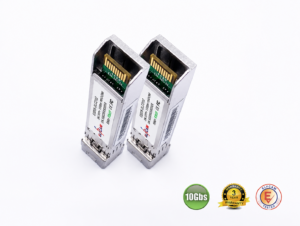
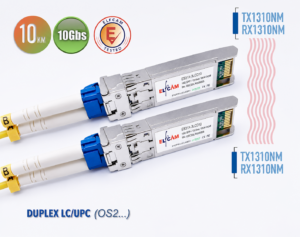
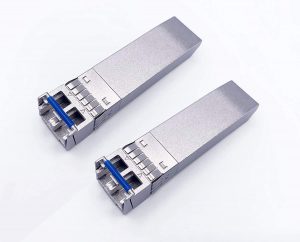
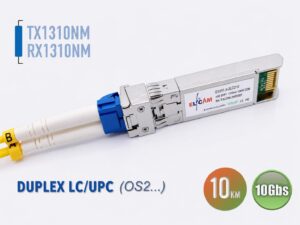
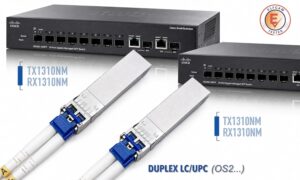
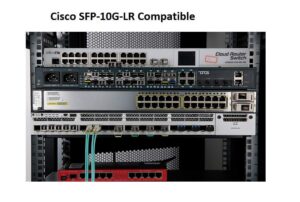
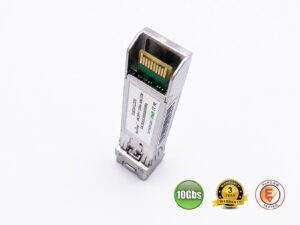
Pour les liaisons jusqu'à 80 km sans amplification, les modules ZR/ER à 1550 nm offrent les meilleures portées. La gamme Elfcam comprend des modules 40G ZR4 (80 km) et 25G LR (80 km) compatibles avec les principales marques de switches (Cisco, Arista, Mellanox, HPE, Juniper).
Calculer la portée maximale de son installation
Voici la méthode en 4 étapes pour calculer la portée maximale de votre liaison :
Étape 1 — Relever les caractéristiques des modules : puissance d'émission min/max (dBm) et sensibilité récepteur (dBm) dans la fiche technique du module.
Étape 2 — Calculer le budget optique brut : Budget = Puissance émission min − Sensibilité récepteur
Étape 3 — Soustraire les pertes fixes :
- Connecteurs : 0,3 à 0,5 dB par connecteur (budget prudent : 0,5 dB × nombre de connecteurs)
- Épissures à fusion : 0,05 à 0,1 dB par épissure
- Marge de garde : 3 dB minimum (vieillissement, variations thermiques, tolérance)
Étape 4 — Diviser par l'atténuation du câble :
- OS2 à 1310 nm : 0,35 dB/km
- OS2 à 1550 nm : 0,20 dB/km
- OM3/OM4 à 850 nm : 3,5 dB/km
Si la distance calculée est inférieure à votre besoin, plusieurs solutions existent : utiliser un module à plus forte puissance d'émission, passer à une fenêtre de longueur d'onde plus favorable (1550 nm au lieu de 1310 nm), réduire le nombre de connecteurs, ou intégrer un amplificateur optique (EDFA) sur la liaison.
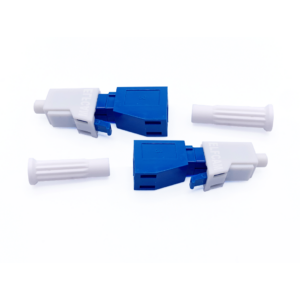
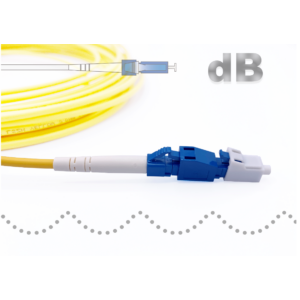
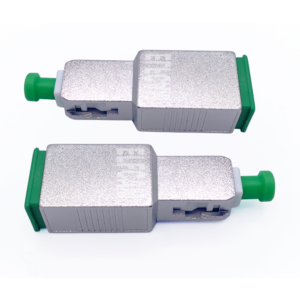
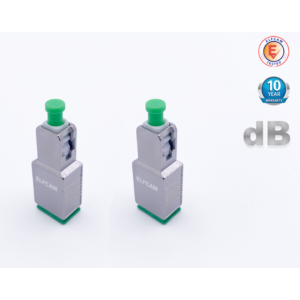
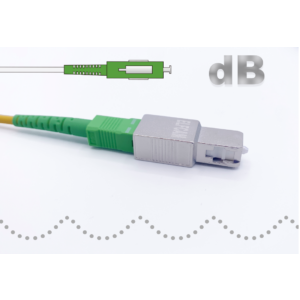
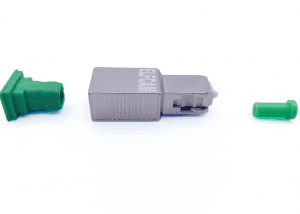
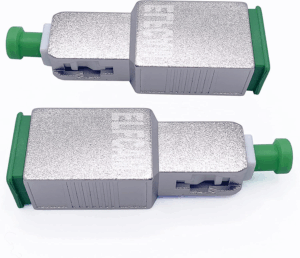
Si au contraire la puissance est trop élevée pour votre liaison courte (risque de saturation du récepteur), des atténuateurs fixes en ligne permettent d'ajuster le niveau de puissance reçu dans la plage acceptable du récepteur.

1Quelle est la portée maximale théorique d'une fibre optique ?
Il n'y a pas de limite théorique absolue : avec des amplificateurs EDFA espacés tous les 80–100 km, les systèmes DWDM sous-marins transportent des centaines de Tbit/s sur des milliers de kilomètres. La liaison sous-marine FLAG (Fiber-optic Link Around the Globe) couvre 28 000 km. En pratique sans amplification, les distances atteignables sont : 550 m (10G multimode OM3), 10 km (10G monomode LR), 40 km (ER), 80 km (ZR), 120+ km avec des modules spéciaux.
2Peut-on augmenter la portée d'une liaison fibre existante ?
Oui, plusieurs approches : remplacer les modules par des modèles à plus forte puissance (ex: passer de LR à ER ou ZR), changer la longueur d'onde de 1310 nm à 1550 nm (atténuation 40 % plus faible), réduire les pertes passives (nettoyage des connecteurs, remplacement des adaptateurs usés), ou installer un amplificateur optique EDFA en milieu de liaison. Le nettoyage des connecteurs seul peut récupérer 1 à 3 dB, soit plusieurs kilomètres supplémentaires.
3Quelle différence de portée entre 1310 nm et 1550 nm ?
L'atténuation d'une fibre OS2 est de 0,35 dB/km à 1310 nm contre 0,20 dB/km à 1550 nm, soit 40 % moins d'atténuation à 1550 nm. Avec un budget optique identique de 14 dB (budget module typique) et 2 dB de pertes fixes (connecteurs, épissures), la portée passe de ~34 km à 1310 nm à ~60 km à 1550 nm. C'est pourquoi les systèmes longue distance utilisent systématiquement la fenêtre 1550 nm.
4Un câble fibre optique multimode peut-il transmettre sur 10 km ?
Non, en pratique. La dispersion modale des fibres multimode limite la portée à quelques centaines de mètres pour les débits 10 Gbit/s et au-delà. À 1 Gbit/s, une fibre OM3 peut techniquement atteindre 1 000 m — mais à 10 km, les pertes par atténuation (3,5 dB/km × 10 km = 35 dB) dépassent largement le budget optique disponible. Pour 10 km, utilisez systématiquement de la fibre monomode OS2 avec des modules SFP+ LR.
5À quoi sert un atténuateur optique sur une liaison fibre ?
Sur une liaison très courte (quelques mètres à quelques centaines de mètres), la puissance optique reçue peut dépasser la plage de sensibilité du récepteur, provoquant sa saturation et des erreurs binaires. Un atténuateur fixe en ligne (1, 2, 3, 5, 10, 15 dB) insère une perte calibrée pour ramener la puissance reçue dans la plage acceptable. Les atténuateurs Elfcam sont disponibles en connecteurs LC/UPC, SC/APC et FC/PC en versions fixes ou variables.
6Quelle est la portée maximale du GPON en réseau FTTH ?
Le standard GPON classe B+ (ITU G.984) spécifie une portée maximale de 20 km entre l'OLT et l'ONU le plus éloigné, avec un budget optique de 28 dB. Ce budget absorbe les pertes du câble de distribution, des épissures et des splitteurs PLC (typiquement 15–18 dB pour un 1:32). L'XGS-PON (G.9807.1, classe N2) offre un budget similaire à 10 Gbit/s. Des OLT à budget étendu (PR30 = 30 dB) permettent d'atteindre jusqu'à 60 km ou des ratios de split plus élevés.
7Comment mesurer les pertes réelles d'une liaison fibre ?
Deux méthodes complémentaires : l'OPM (puissancemètre optique) + source lumineuse mesure la perte d'insertion totale de bout en bout (méthode insertive, selon IEC 61280-4-1). L'OTDR (réflectomètre optique) localise chaque défaut sur le trajet — épissure, connecteur, rupture — avec leur position et leur atténuation individuelle. La méthode OTDR est obligatoire pour les certifications opérateurs FTTH et les chantiers télécoms.
8Quels délais pour recevoir des modules SFP longue portée Elfcam ?
Les modules SFP+ LR (10G/10 km), SFP28 LR (25G/10 km), QSFP+ LR4 (40G/10 km) et QSFP28 LR4 (100G/10 km) sont disponibles en stock France avec expédition sous 24h. Les modules grande portée (ER/ZR, 40–80 km) et les atténuateurs optiques sont également en stock. Compatibles avec les équipements Cisco, Arista, Mellanox/Nvidia, HPE, Juniper, Marvell et Freebox Ultra. Livraison express disponible pour les projets urgents.