Classification of Optical Fibres — Single-mode, Multimode and Performance
Contents
Not all optical fibres are equal. The type of fibre determines the bandwidth, distance, compatibility and cost of your installation. This article classifies fibres by transmission mode (single-mode vs multimode), details the standards (OS2, OM1 to OM5) and explains the performance characteristics to know to choose the right cable.
Classification by transmission mode
The propagation mode in an optical fibre depends on the diameter of the core. This is the most fundamental classification criterion.
Single-mode fibre (SMF — Single Mode Fiber)
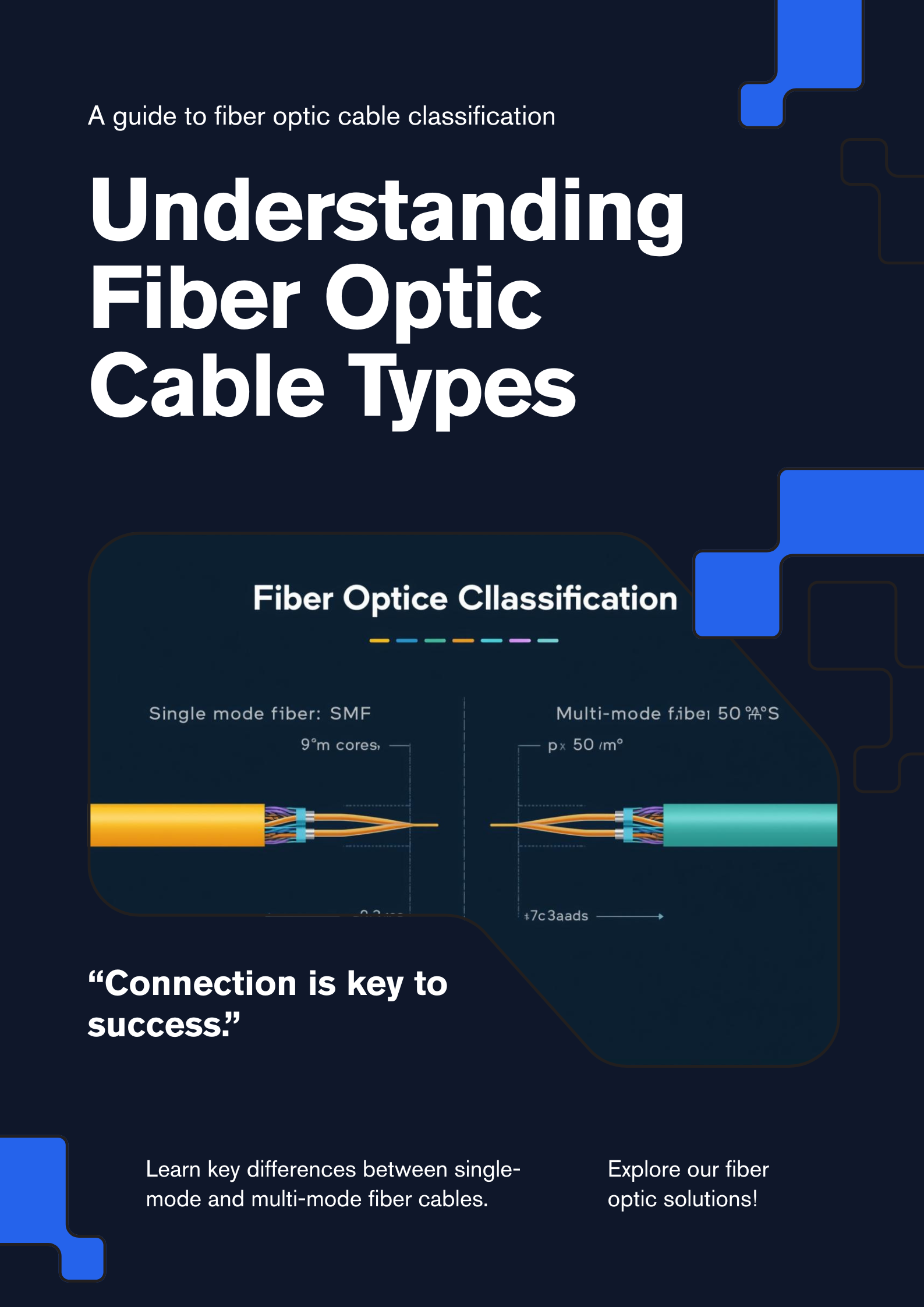
The single-mode fibre has a very thin core (9 µm) that allows only one mode of light to pass. The result: no modal dispersion, which allows transmission over very long distances (10 to 80+ km) without significant signal loss.
- Core diameter: 9 µm
- Cladding: 125 µm
- Wavelength: 1310 nm and 1550 nm
- Standard: OS2 (ITU-T G.652D, G.657A2)
- Distance: 10–80+ km
- Usage: FTTH, telecom, campus, inter-building, backbone
Multimode fibre (MMF — Multi Mode Fiber)
The multimode fibre has a larger core (50 µm or 62.5 µm) that allows multiple modes of light to pass. Modal dispersion limits transmission distance, but the wide core makes coupling easier and reduces the cost of transmitters (LED instead of laser).
- Core diameter: 50 µm (OM3/OM4/OM5) or 62.5 µm (OM1/OM2)
- Cladding: 125 µm
- Wavelength: 850 nm (and 1300 nm for some)
- Standards: OM1, OM2, OM3, OM4, OM5
- Distance: 100 m to 550 m depending on standard and bandwidth
- Usage: data centres, server rooms, rack-to-rack links
Simple rule: single-mode for distances > 300 m and telecom links. Multimode for data centres and short distances where cost is the priority.
Single-mode fibre (SMF) in detail
ITU-T Standards
Single-mode fibre is standardised by the ITU-T (International Telecommunication Union):
- G.652D: standard single-mode fibre, the most widely used. Used in all telecom and FTTH installations.
- G.657A1: reduced-bend fibre (radius 10 mm). Suitable for indoor installations.
- G.657A2: very-low-bend fibre (radius 7.5 mm). Ideal for home installations with tight bends. This is the fibre used in Elfcam cables.
- G.657B3: ultra-flexible fibre (radius 5 mm). For micro-cables and micro-ducts.
Elfcam single-mode cables (G657A2)
- Indoor fibre cables — SC/APC, LC/UPC single-mode patch cords
- Outdoor armoured cables — steel armoured and LSZH, G657A2 fibre
- Single-mode pigtails — packs of 12/24/48 fibres, all connectors
Common single-mode connectors
Single-mode fibres mainly use the SC/APC connectors (green, FTTH standard), LC/UPC (blue, switches and SFP), and LC/APC (green, long distance). See our fibre accessories page for couplers and adapters.
Multimode fibre (MMF) in detail
The 5 OM standards
Multimode fibres are classified from OM1 (the oldest) to OM5 (the most recent). The OM number corresponds to the modal bandwidth — the higher the number, the better the performance.
| Standard | Core | Bandwidth | 1G Distance | 10G Distance | Jacket colour | Typical use |
|---|---|---|---|---|---|---|
| OM1 | 62.5 µm | 200 MHz·km | 275 m | 33 m | Orange | Legacy, to be replaced |
| OM2 | 50 µm | 500 MHz·km | 550 m | 82 m | Orange | Existing networks |
| OM3 | 50 µm | 2000 MHz·km | 550 m | 300 m | Aqua | Standard data centre |
| OM4 | 50 µm | 4700 MHz·km | 550 m | 400 m | Aqua / Violet | High-perf. data centre |
| OM5 | 50 µm | 4700 MHz·km | 550 m | 400 m | Lime green | SWDM, 40/100G multi-λ |
Recommendation
For a new multimode installation, choose OM3 as a minimum. OM4 is preferable if you target 10G or plan to evolve to 40G/100G. OM1 and OM2 are obsolete.
Single-mode vs multimode: full comparison table
| Criterion | Single-mode (OS2) | Multimode (OM3/OM4) |
|---|---|---|
| Core | 9 µm | 50 µm |
| Wavelength | 1310 / 1550 nm | 850 nm |
| Light source | Laser (DFB) | VCSEL (LED) |
| 1 Gbps distance | 10–80 km | 550 m |
| 10 Gbps distance | 10–40 km | 300–400 m |
| Dispersion | Chromatic only | Modal + chromatic |
| Cable cost | Comparable | Comparable |
| Module cost | Higher (laser) | Lower (VCSEL) |
| Jacket colour | Yellow (standard) | Orange / Aqua / Lime |
| Main use | Telecom, FTTH, campus | Data centre, rack-to-rack |
Key performance characteristics
Attenuation (signal loss)
Attenuation measures the optical power loss per kilometre. The lower it is, the further the fibre can transmit.
- Single-mode at 1310 nm: 0.35 dB/km
- Single-mode at 1550 nm: 0.22 dB/km (best performance)
- Multimode at 850 nm: 2.5–3.5 dB/km
Dispersion
Dispersion broadens light pulses during transmission, which limits the bandwidth over long distances.
- Modal dispersion: only exists in multimode. The different modes arrive at different times.
- Chromatic dispersion: exists in both types. The different wavelengths propagate at slightly different speeds.
Bandwidth
Measured in MHz·km for multimode. The higher the number, the more bandwidth the fibre supports over a given distance. OM3 offers 2000 MHz·km, OM4 reaches 4700 MHz·km.
Return loss
The amount of light reflected back to the source at the connectors. APC connectors (8° angled polish) offer a return loss ≥ 60 dB (excellent), compared to ≥ 50 dB for UPC.
Elfcam optical modules by fibre type
- Single-mode SFP modules — 1G, 1310/1550 nm, LC duplex, 10–80 km
- SFP+ 10G single-mode modules — 10G, 1310 nm, LC duplex, 10 km
- SFP+ 10G multimode modules — 10G, 850 nm, LC duplex, 300 m (OM3/OM4)
How to choose the right fibre type
The choice comes down to 3 questions:
- What distance? — > 300 m → single-mode. < 300 m → multimode possible.
- What bandwidth? — 1 Gbps → single-mode or multimode. 10 Gbps → single-mode or OM3/OM4. 40/100 Gbps → OM4/OM5 or single-mode.
- What environment? — Telecom/FTTH → single-mode mandatory. Data centre → multimode often more cost-effective. Home → single-mode (G657A2).
When in doubt, choose single-mode. The extra cost of laser modules is offset by versatility, distance and scalability. It's an investment that will never be obsolete.
Home fibre installation guide
- Home Fiber — full guide to install a home fibre network
- Fibre converters — plug & play link, integrated SFP
- 10G Switches — multi-gig backbone for Freebox Ultra