FTTC and FTTP: differences, architecture and fibre optic deployment
Contents
You hear about fibre optic, but your internet offer is sometimes classified as FTTC and sometimes as FTTP. What's the practical difference? One still uses copper on the last stretch, the other brings fibre optic all the way to your premises. This distinction determines your actual speeds, latency and the longevity of your connection over 10 years. This technical guide explains both architectures, their deployment in France and the associated connection equipment.
FTTC and FTTP definitions
The acronyms FTTC and FTTP belong to the FTTx family (Fiber To The x), which groups all architectures where fibre optic partially or fully replaces the legacy copper network.
FTTC — Fiber To The Cabinet means fibre optic reaches a street cabinet (sub-distributor or NRA-MeD), then a twisted-pair (copper) cable covers the last kilometre to the subscriber. The signal on this last segment uses xDSL technologies — mainly VDSL2 (ITU G.993.2) or its evolution G.fast (ITU G.9700).
FTTP — Fiber To The Premises means fibre optic reaches the building or the subscriber's premises. In practice, FTTP is synonymous with FTTH (Fiber To The Home) for residential users or FTTB (Fiber To The Building) for multi-dwelling buildings. No copper is involved in the signal path.
The fundamental difference: with FTTC the signal travels through copper on the last kilometre, with FTTP it stays on fibre optic all the way to the subscriber's PTO.
FTTC architecture: fibre + copper
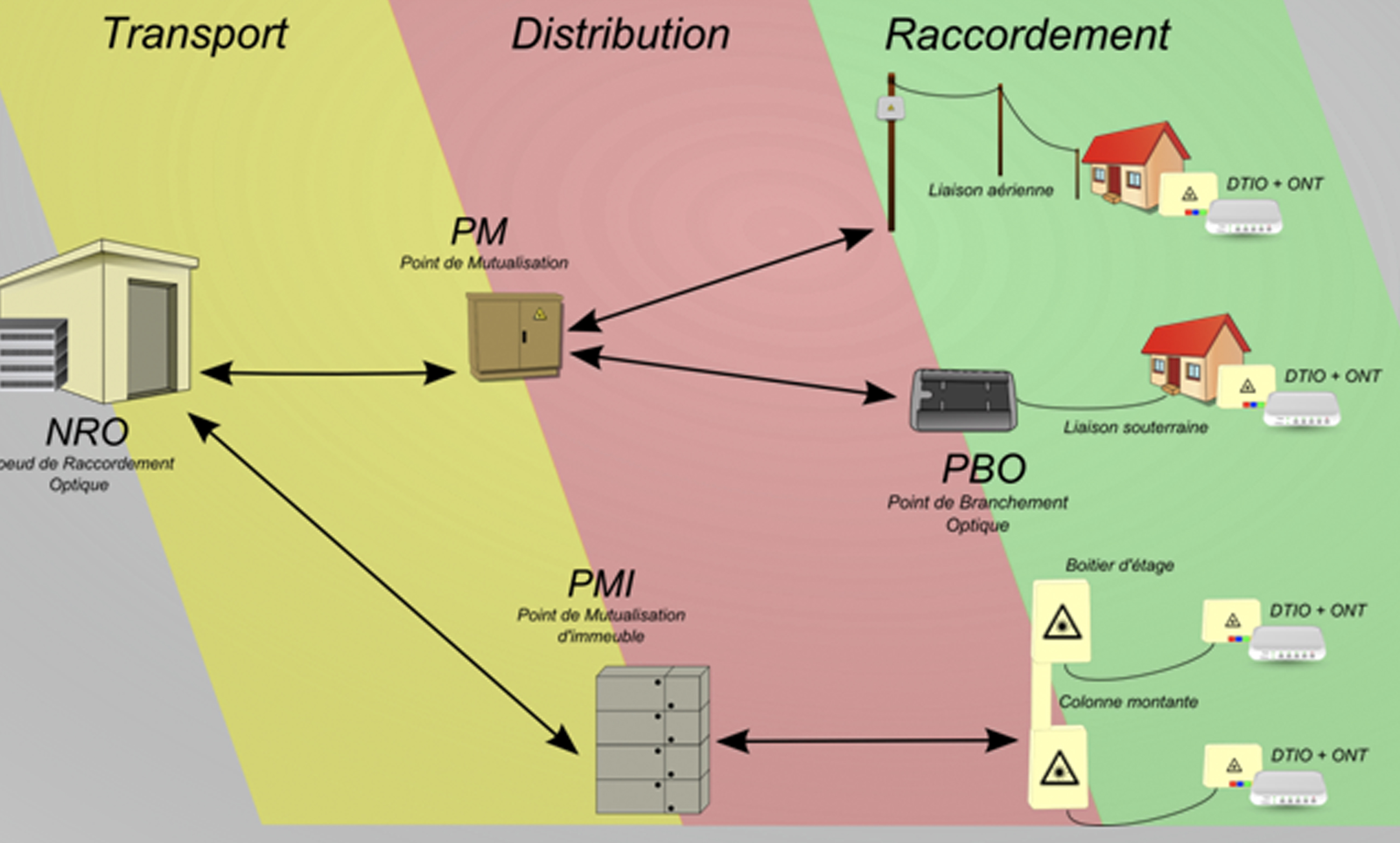
With FTTC, the operator runs fibre optic from its optical connection node (NRO) to a sub-distributor on the street, where a DSLAM (Digital Subscriber Line Access Multiplexer) sits. This DSLAM injects the xDSL signal onto the existing copper pairs of the telephone network.
The remaining copper distance is the limiting factor. With VDSL2:
- At 300 m: ~100 Mbps download
- At 500 m: ~50–70 Mbps
- At 1 km: ~25–35 Mbps
- Beyond 1.5 km: classic ADSL performance
The G.fast technology pushes these limits provided the sub-distributor is very close (less than 250 m): aggregate speeds of 300 to 500 Mbps are achievable. But G.fast deployment remains marginal in France, limited to a few dense neighbourhoods.
The advantage of FTTC: reuse of the existing copper network, which considerably reduces deployment cost. The downside: asymmetric speeds, sensitivity to electromagnetic interference, attenuation increasing with distance and inability to reach gigabit speeds.
FTTP architecture: fibre all the way
With FTTP, fibre optic is pulled from the NRO to the PTO (Optical Termination Outlet) installed in the subscriber's home. The entire path is optical: no electrical conversion occurs between the NRO and the subscriber's ONT/box.
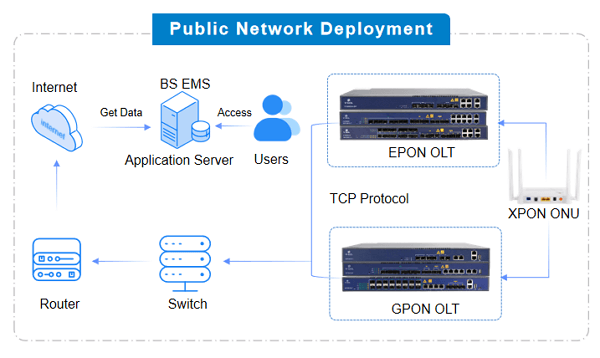
The transport architecture used in France is almost exclusively GPON (Gigabit Passive Optical Network, ITU G.984) or its successor XGS-PON (ITU G.9807.1). A single fibre cable from the OLT (at the operator) feeds up to 64 subscribers via passive PLC splitters, with no electrical power in the distribution.
- GPON: 2.5 Gbps downstream / 1.25 Gbps upstream, shared between subscribers
- XGS-PON: 10 Gbps symmetric, deployed for 2G/8G offers
- Maximum allowed attenuation: 28 dB (class B+), covering up to ~20 km of fibre
The subscriber receives an ONT (Optical Network Terminal) built into the box or as a separate module. It converts the optical signal into an Ethernet signal for the local network.
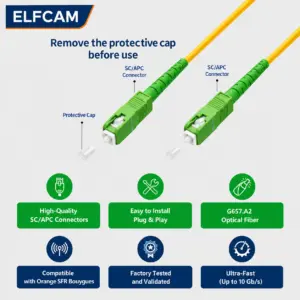
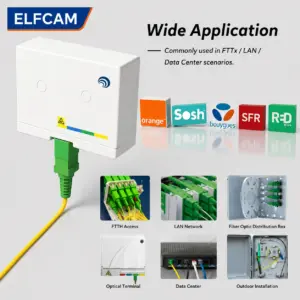
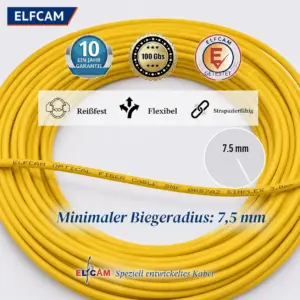
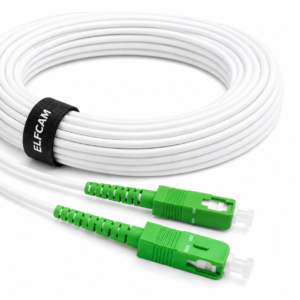
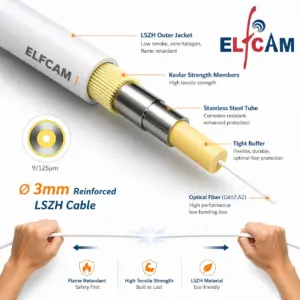
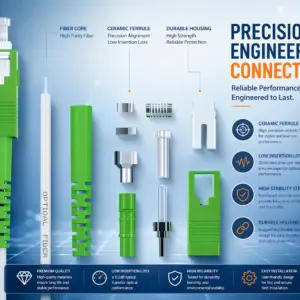
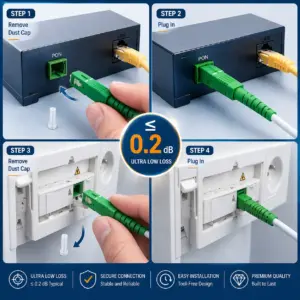
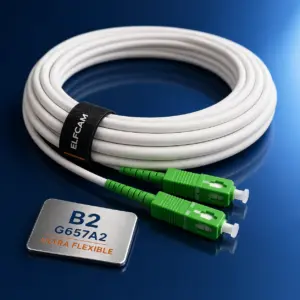
FTTP connection: Elfcam components
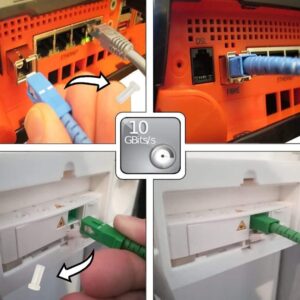
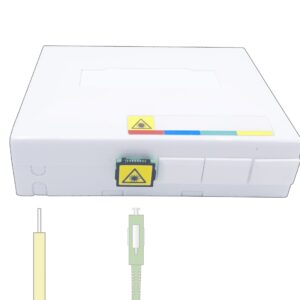
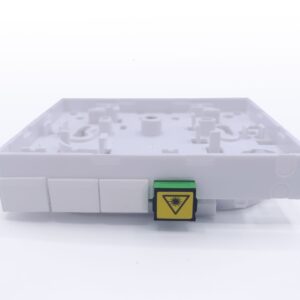
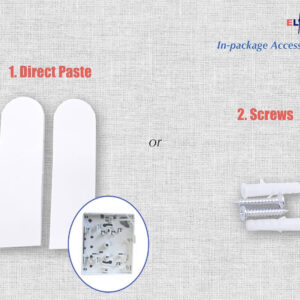
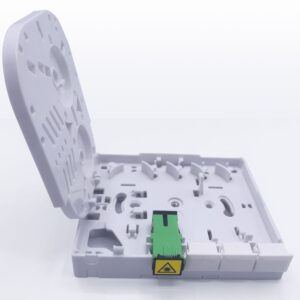
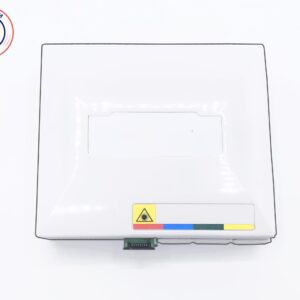
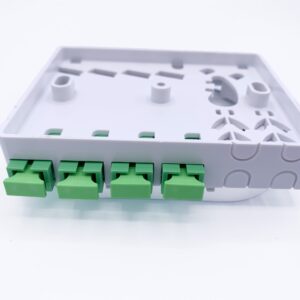
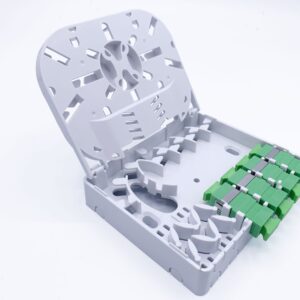
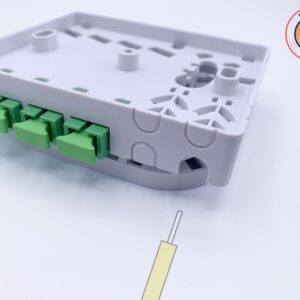
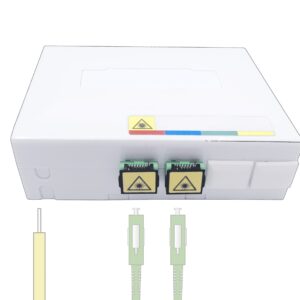
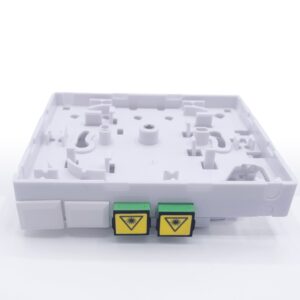
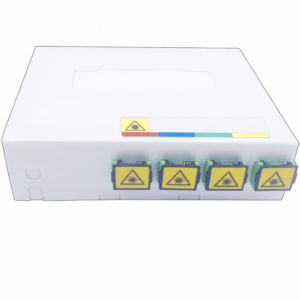
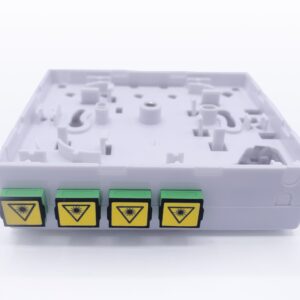
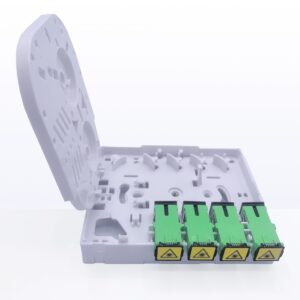
- PTO SC/APC — optical termination outlet for indoor termination
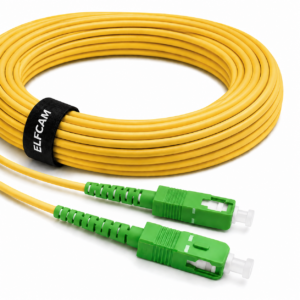
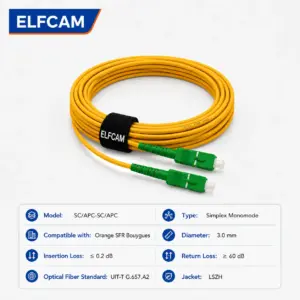
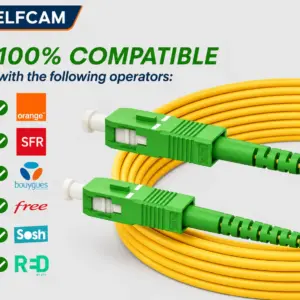
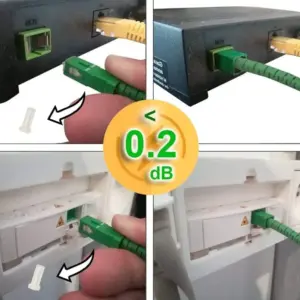
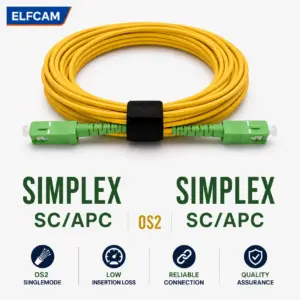
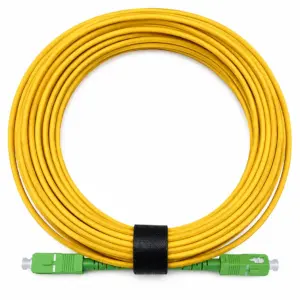
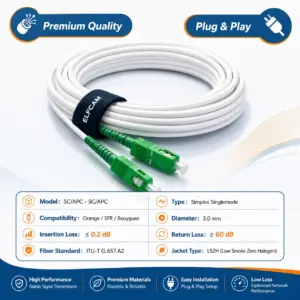
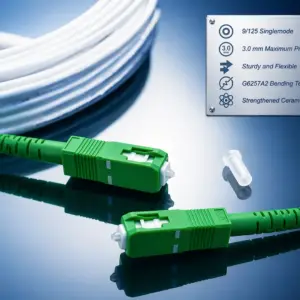
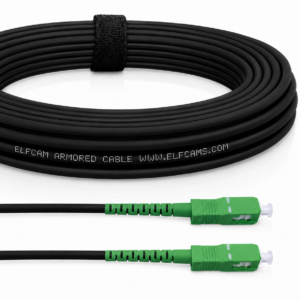
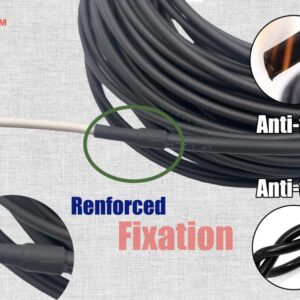
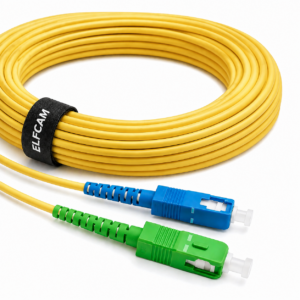
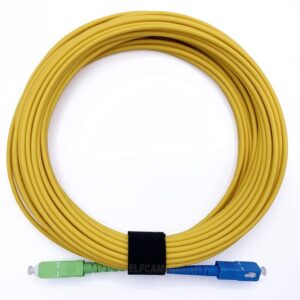
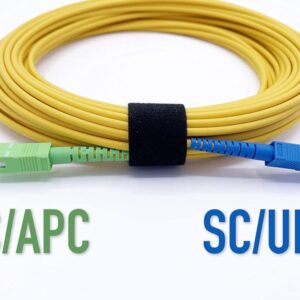
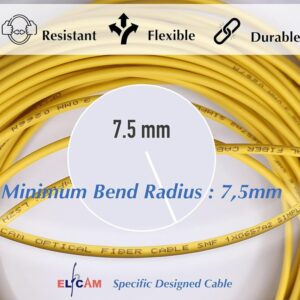
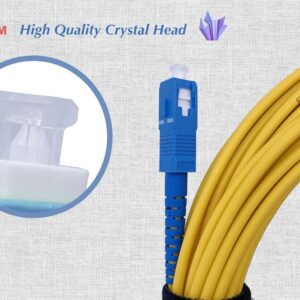
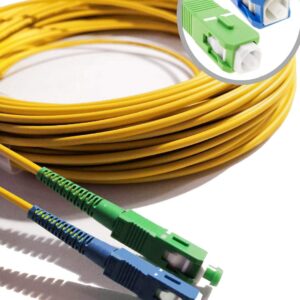
- SC/APC OS2 patch cords — connection cable between PTO and ONT/box
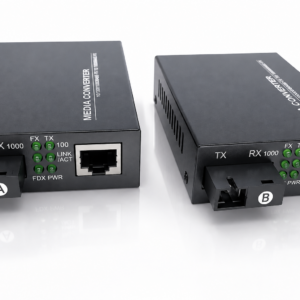
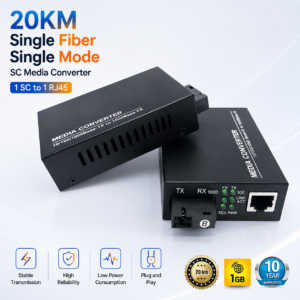
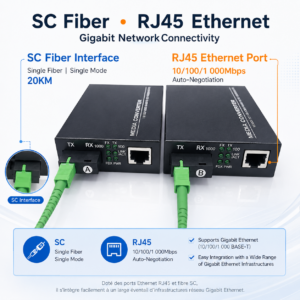
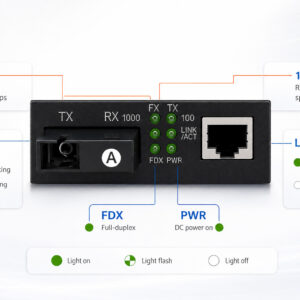
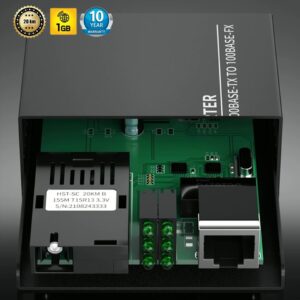
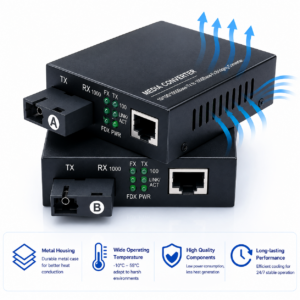
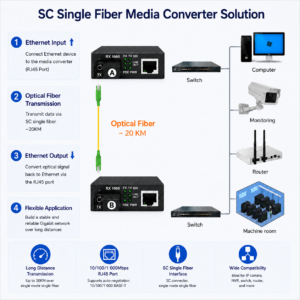
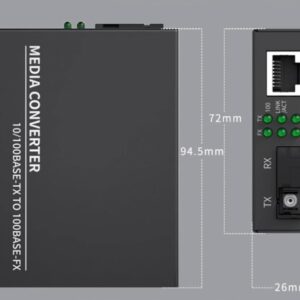
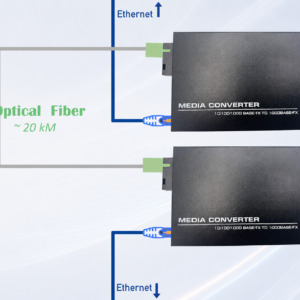
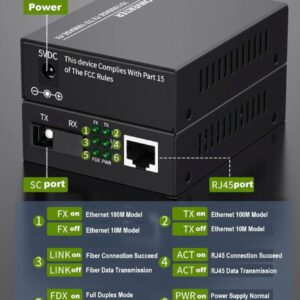
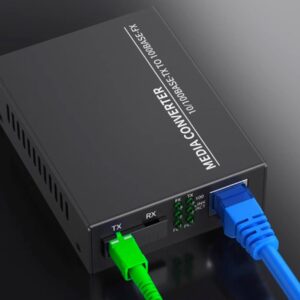
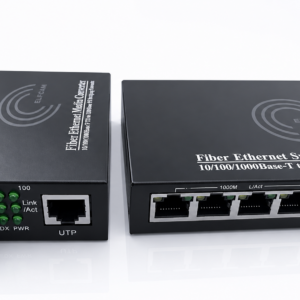
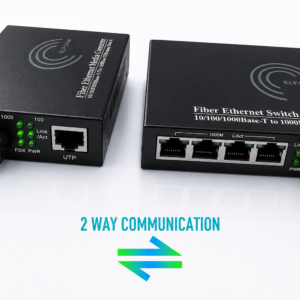
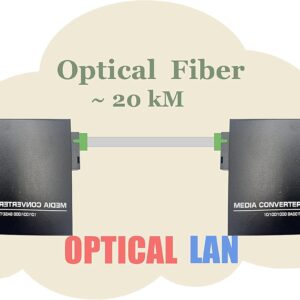
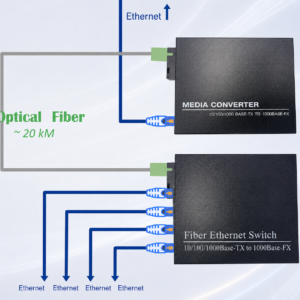
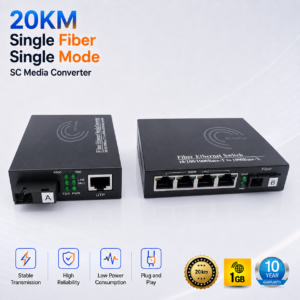
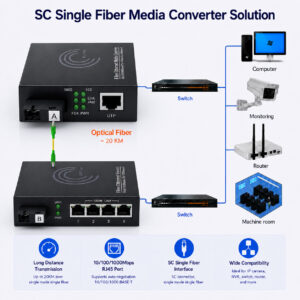
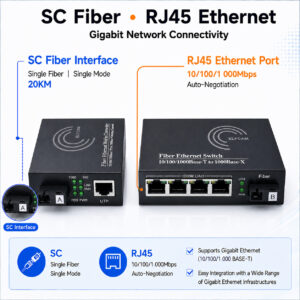
- Fibre-to-Ethernet converter — to extend the optical connection over a local network

FTTC vs FTTP comparison table
| Criterion | FTTC (Fiber To The Cabinet) | FTTP / FTTH (Fiber To The Premises) |
|---|---|---|
| Last mile | Copper (twisted pair) | Fibre optic |
| Signal technology | VDSL2 / G.fast | GPON / XGS-PON |
| Max downstream speed | 100–500 Mbps (distance-dependent) | 1 Gbps to 8 Gbps |
| Upstream speed | 10–50 Mbps | 600 Mbps to 8 Gbps |
| Typical latency | 10–20 ms | 2–5 ms |
| Symmetry | Strongly asymmetric | Symmetric available (XGS-PON) |
| Maximum distance | 1–2 km from the Cabinet | Up to 20 km from the OLT |
| Interference sensitivity | High (crosstalk, noise) | None (isolated optical signal) |
| Deployment cost | Low (existing copper network) | High (civil works, fibre pulling) |
| Longevity | Limited — copper being phased out | Long term — infrastructure 30+ years |
| Active equipment in distribution | DSLAM (powered) | Passive PLC splitters (unpowered) |
| In France | Orange copper network (closure 2030–2034) | National standard — 80% of premises eligible |
Real-world performance in France
FTTC speeds depend directly on the length of the copper segment between the Cabinet and the subscriber. In dense urban areas where Cabinets are close, VDSL2 can deliver decent speeds (80–100 Mbps). In peri-urban or rural areas, the same "fibre to the Cabinet" offer often only guarantees 20–40 Mbps in real-world conditions.
With FTTP/FTTH, speeds are stable regardless of the distance to the OLT, because the optical signal hardly attenuates over 10–15 km of OS2 single-mode fibre. Commercial offers in France commonly provide:
- 1 Gbps: standard offer (GPON) — Orange, SFR, Bouygues, Free
- 2 Gbps: XGS-PON offer — Free Révolution, SFR Fibre 2G
- 8 Gbps: premium XGS-PON offer — Freebox Ultra (since 2024)
Tip: measure your link quality
Before investing in network equipment, check your actual speed with an iPerf test or nperf.fr. With FTTP, if you don't reach 80% of the advertised speed, the cause is often the patch cord between the PTO and the box (excessive insertion loss) — replace it with an Elfcam shielded SC/APC OS2 cable.
Deployment in France
France chose FTTH as the national architecture via the France Très Haut Débit plan launched in 2013. The objective: 80% of premises connectable via fibre optic by 2025, full coverage before 2027.
The FTTC network in France is operated essentially by Orange on its copper network (around 35 million lines). Since 2023, Orange has officially confirmed the gradual closure of the copper network, with a schedule planned from 2026 to 2034, department by department. Around 2,000 municipalities have already received a closure notice.
The four national operators (Orange, SFR, Bouygues Telecom, Free) all deploy their FTTP offers in:
- Very dense areas (ZTD): each operator pulls its own fibre
- AMII / AMEL zones: deployment by Orange or SFR, mutualised access for other operators
- RIP zones: public initiative networks (local authorities) deployed via DSP
The cable used for FTTP distribution is systematically single-mode OS2 fibre (ITU G.652D or G.657A2/B3 for constrained areas). In-building connections use ribbon cables or micro-cables laid in micro-ducts.
Equipment and subscriber-side connection
With FTTC, subscriber equipment is simple: an xDSL modem-router (provided by the operator) with an RJ11 port on the line side and RJ45/Wi-Fi ports on the local network side. The technician connects the existing copper cable — no fibre patch cord is needed at the subscriber's home.
With FTTP, the subscriber connection includes several components:
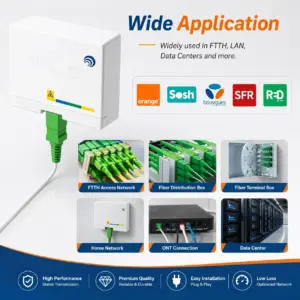
- PTO (Optical Termination Outlet): interface between the outdoor drop cable and the indoor patch cord. SC/APC connector. Installed by an operator technician.
- SC/APC–SC/APC patch cord: linking cable between the PTO and the ONT or box. Typical length: 3 to 15 m. Must be OS2 single-mode type.
- ONT / box: converts the optical signal to Ethernet. Either built into the box (Livebox 6, Freebox Ultra), or external (SFP module in some pro routers).
Beware of the connector type
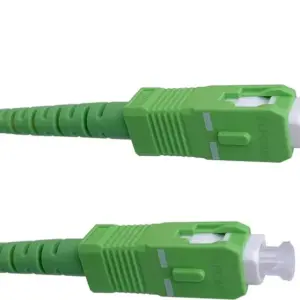
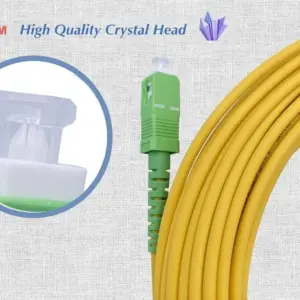
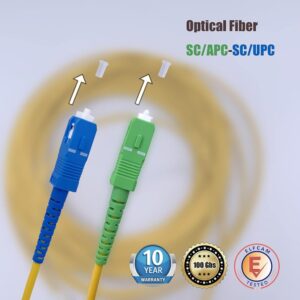
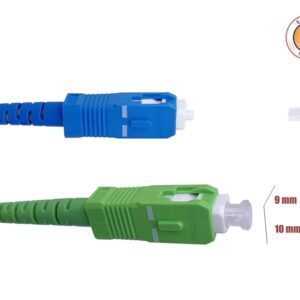
In France, the standard connector on residential PTOs is SC/APC (green 8° angled bevel). Do not confuse it with SC/UPC (blue, flat face). An SC/UPC patch cord plugged into an SC/APC PTO generates very high return loss and can significantly degrade speed. Check the connector colour before purchase.

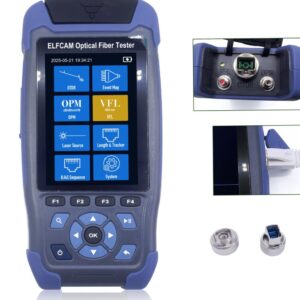
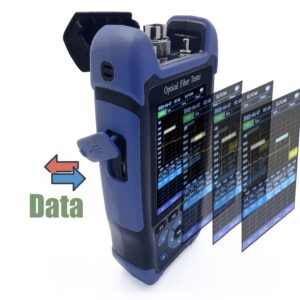
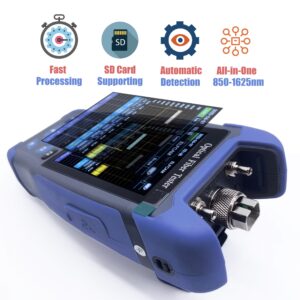
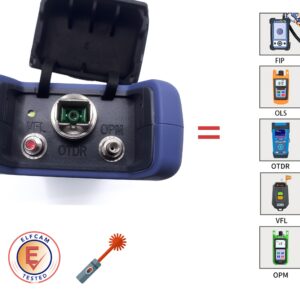
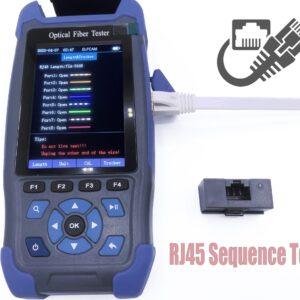
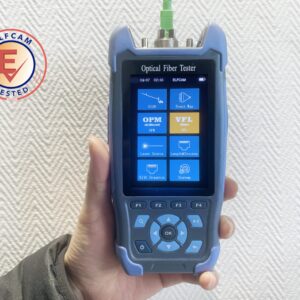
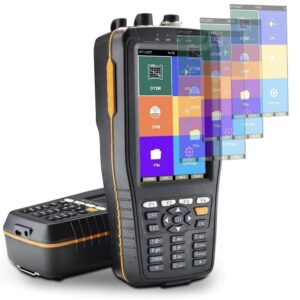
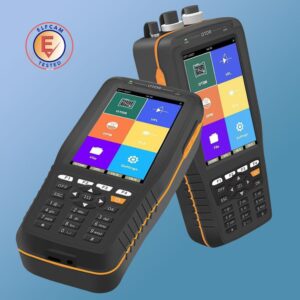
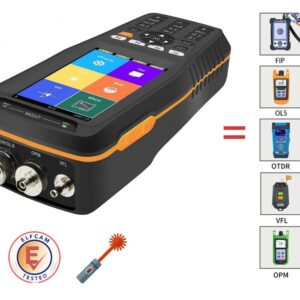
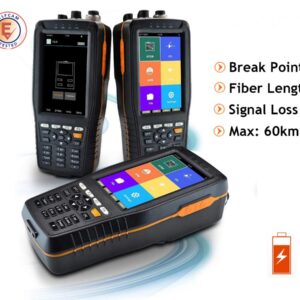
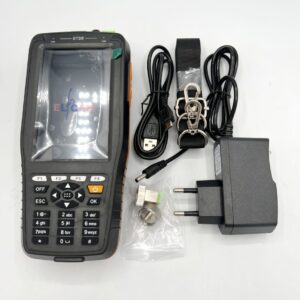
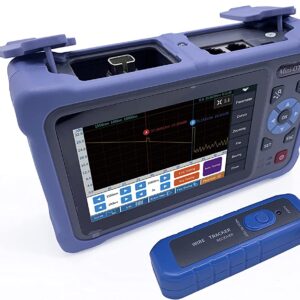
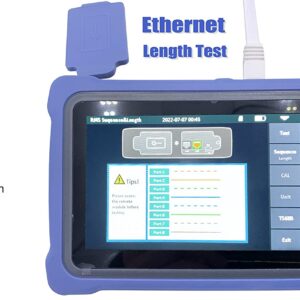
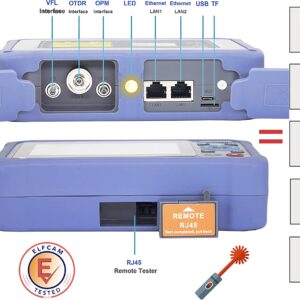
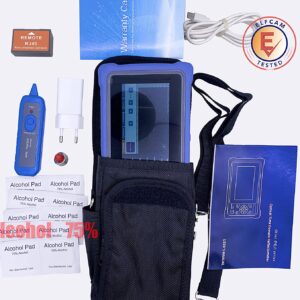
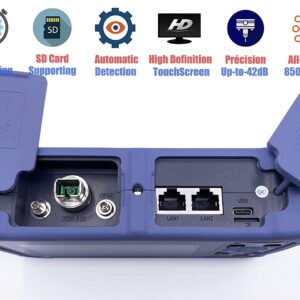
For professional installations, datacentres or FTTP campuses, OTDRs (Optical Time-Domain Reflectometers) make it possible to certify each link and identify any breaks or faulty splices.


1What is the main difference between FTTC and FTTP?
With FTTC, fibre optic reaches a street Cabinet, then the signal is carried over a copper pair to the subscriber (VDSL2 or G.fast technology). With FTTP, fibre optic is pulled all the way to the subscriber's premises or building — no copper is involved. The difference is fundamental in terms of speed (100 Mbps max for FTTC vs 1–8 Gbps for FTTP) and latency (10–20 ms vs 2–5 ms).
2Are FTTP and FTTH the same thing?
FTTP (Fiber To The Premises) is the generic term designating any architecture where fibre reaches the building. FTTH (Fiber To The Home) is a subcategory of FTTP specific to individual homes. In practice in France, both terms mean the same thing for a residential user. FTTB (Fiber To The Building) is a variant where fibre arrives in the building's technical room, then an Ethernet cable distributes to the apartments.
3What speed can you expect with FTTC?
FTTC speed depends directly on the distance between the street Cabinet and your home. With VDSL2: about 100 Mbps at 300 m, 50–70 Mbps at 500 m, 25–35 Mbps at 1 km. Beyond 1.5 km, performance matches that of ADSL. With G.fast (rare in France), you can exceed 300 Mbps but only at less than 250 m from the Cabinet. These speeds are asymmetric: the upstream speed is 5 to 10× lower than the downstream.
4Will the FTTC copper network disappear in France?
Yes. Orange has officially planned the closure of the copper network between 2026 and 2034. The process takes place municipality by municipality, with notification 3 years before effective closure in each area. FTTC subscribers must migrate to FTTH before shutdown. Around 2,000 municipalities had already received notification in 2024–2025. By the end of 2025, more than 35% of copper lines already had a fibre equivalent available.
5Which fibre patch cord should I use between my PTO and my box?
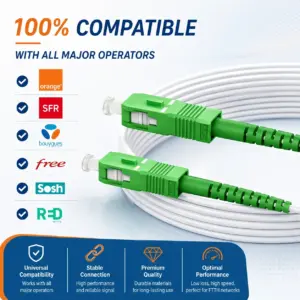
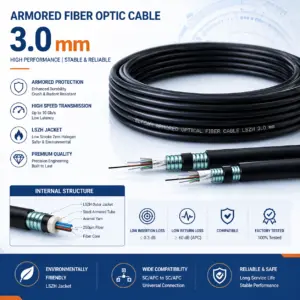
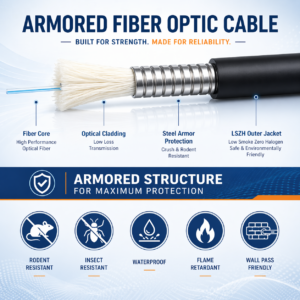
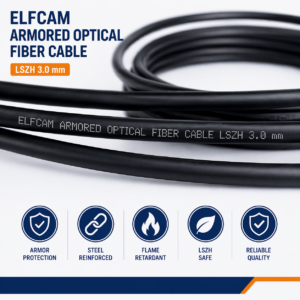
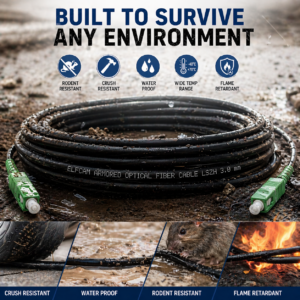
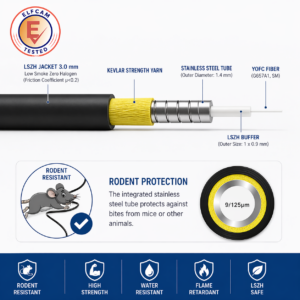
In France, use an SC/APC–SC/APC OS2 simplex patch cord (green 8° angled bevel connector, 9/125 µm single-mode fibre). Carefully check the connector on the box side: Orange Livebox uses SC/APC, Free Freebox uses SC/APC, SFR Box 8 uses SC/APC. For greater durability, choose a shielded patch cord (steel armour) if the cable must pass through a mechanical-risk area. Elfcam SC/APC cables are certified with insertion loss ≤ 0.3 dB.
6What technology do FTTP operators use in France?
The vast majority of residential FTTP deployments in France use GPON (ITU G.984, 2.5 Gbps downstream / 1.25 Gbps upstream) or XGS-PON (ITU G.9807.1, 10 Gbps symmetric) for high-end offers (Free Ultra 8G, SFR 2G). Both standards use passive PLC splitters (1:32 or 1:64) to share a fibre between several subscribers. The active equipment (OLT) is concentrated at the operator in the NRO.
7Can a technician certify an FTTC or FTTP installation themselves?
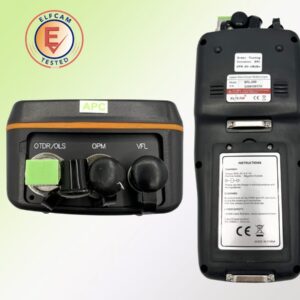
Yes, with an OTDR reflectometer (Optical Time-Domain Reflectometer), a technician can measure the losses of each splice and connector on an FTTP fibre, locate breaks and certify compliance with the optical budget. For operator certifications (Orange, SFR), approved OTDRs and calibrated power meters are required. The Elfcam ELF-3800 and ELF-4800 OTDRs cover the 1310/1550 nm ranges suited to GPON networks.
8How long does an FTTP home installation take?
If your home is already connectable (building riser or outdoor connection box present), FTTP activation generally takes 2 to 4 weeks after subscription, with an operator technician's intervention. If outdoor cable pulling is required, lead times can extend to 2–3 months. Elfcam equipment (patch cords, PTO, converters) is available in stock in France with 24h shipping to avoid blocking the installation on the subscriber's side.