FTTx, FTTH, FTTB, FTTC: fibre architectures explained — ONU vs ONT
Contents
You hear about FTTH, FTTB, ONU and ONT without really telling them apart? You are not alone. These acronyms refer to precise technical realities — and understanding their differences is essential for designing, deploying or maintaining a high-performance fibre network.
This guide decodes FTTx from A to Z: FTTH, FTTB, FTTC and FTTdp architectures, how the PON network works, and the famous distinction between ONU and ONT. With 40,000+ installations supported, the Elfcam team has answered these questions hundreds of times — here is the complete answer.
FTTx is a family of network architectures where optical fibre replaces copper over all or part of the path between the operator and the subscriber. The "x" varies depending on where the fibre stops.
What is FTTx?
FTTx stands for Fiber To The x — literally "fibre to the x". This "x" represents the termination point of the fibre in the access network: home, building, street cabinet or kerb. It is a generic term that encompasses all variants of broadband fibre access.
The common objective of all FTTx architectures is the same: to gradually replace the copper local loop (the legacy telephone network) with optical fibre, in order to increase available speeds and reduce latency. The difference lies in the length of the fibre section and the nature of the possible last segment.
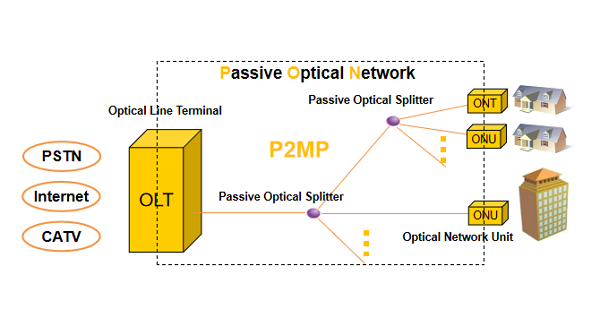
In France, FTTx deployment relies mainly on the PON (Passive Optical Network) network in a point-to-multipoint architecture. A single active device — the OLT at the operator — serves up to 64 or 128 subscribers via passive optical splitters.
FTTH, FTTB, FTTC, FTTdp: the 4 architectures explained
These four variants are distinguished by the location where the fibre stops and by the medium used for the last mile.
FTTH — Fiber To The Home
The fibre arrives directly inside the subscriber's home. This is the highest-performing architecture: symmetrical speeds up to 10 Gbit/s, latency below 5 ms, no degradation related to distance. In France, this is the architecture deployed by Orange, SFR, Free and Bouygues as part of the France Très Haut Débit Plan. An ONU/ONT is installed at the subscriber's premises to convert the optical signal into an electrical signal.
FTTB — Fiber To The Building
The fibre reaches the building's technical room (basement or stairwell). The last section between the technical room and each apartment uses existing cabling: Ethernet, coaxial cable or copper pairs (VDSL2). Speeds reach 300–500 Mbit/s depending on the quality of the internal cabling. An economical solution for older buildings where running fibre to each floor would be too costly.
FTTC — Fiber To The Cabinet
The fibre reaches the street sub-distribution point (neighbourhood cabinet). The last mile uses existing copper pairs with VDSL2 or G.fast technology. Speeds are limited by the length of the remaining copper: 50 Mbit/s at 300 m, 20 Mbit/s at 500 m. This is the intermediate architecture used before the move to full FTTH.
FTTdp — Fiber To The Distribution Point
A variant of FTTC even closer to the subscriber: the fibre reaches the distribution point located less than 100 m from the home. With G.fast or XG-fast, speeds can reach 500 Mbit/s to 1 Gbit/s over a few dozen metres of copper. A transition architecture towards full FTTH.
Tip
To find out which architecture serves your address, check your operator's eligibility verification tool. In dense areas, FTTH is now the majority. In rural areas, FTTC often remains the only option available in the short term.
How a PON network works
Almost all FTTH deployments in France use a PON (Passive Optical Network) architecture. Here is how it works:
At the heart of the network is the OLT (Optical Line Terminal) — the active device located in the telephone exchange or the operator's optical connection node (NRO). It manages all optical signals and communicates with each subscriber.
At the OLT output, the fibre travels to a passive optical splitter. This unpowered device divides the signal into 2, 4, 8, 16, 32 or 64 branches, allowing a single OLT port to serve several dozen subscribers. The word "passive" is key: no active part, no electrical maintenance outside the NRO.
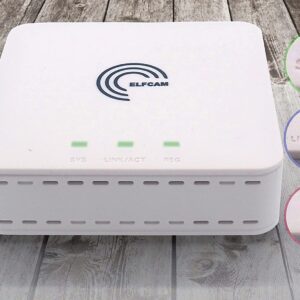
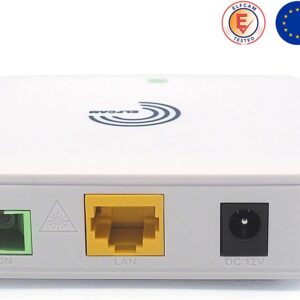
At the end of the chain, at each subscriber, is the ONU or ONT. This device performs the optical/electrical conversion and provides the network interfaces (RJ45, WiFi, telephone ports). It is the only active device on the subscriber side.
Transmission takes place over two distinct wavelengths on the same fibre:
- Downstream (downlink) — from the OLT to the ONUs: 1490 nm (GPON/EPON) or 1577 nm (XGS-PON)
- Upstream (uplink) — from the ONUs to the OLT: 1310 nm (burst laser)
ONU vs ONT: same role, two different standards
This is THE question of this article — and the answer is both simple and often misunderstood.
ONU (Optical Network Unit) and ONT (Optical Network Terminal) refer to the same physical device: the subscriber-side terminal of a PON network. The difference is normative, not functional.
- ONU is the term from the IEEE 802.3ah standard (EPON). It is used in multi-subscriber or building contexts (FTTB, MDU).
- ONT is the term from the ITU-T G.984 standard (GPON). It specifically refers to a terminal installed directly at a single residential subscriber (FTTH).
In practice, equipment manufacturers and integrators use both terms interchangeably. When a French operator delivers you an "ONT box", it is technically a GPON ONU installed in FTTH.
The distinction becomes important in two contexts:
- Writing specifications: the ITU-T distinguishes the ONU (outside the home, can serve several users) from the ONT (inside the home, a single user). An MDU ONU located in a building's technical room and a residential ONT in an apartment are different devices.
- Interoperability: GPON ONUs must be certified by the GPON OLT to which they connect. An EPON ONU will not work on a GPON OLT without xPON compatibility.
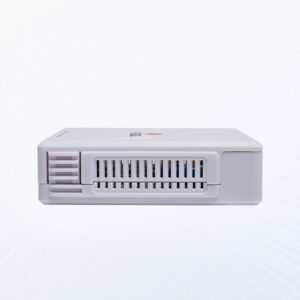
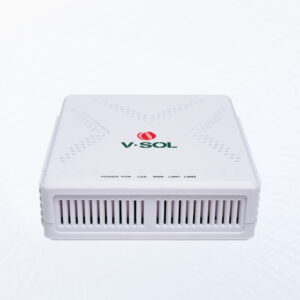
Types of ONU: SFU, HGU, MDU — how to tell them apart
Beyond the GPON/EPON standard, ONUs are distinguished by their deployment profile. ITU-T G.988 defines several categories according to the number of users served and the integrated functions.
SFU — Single Family Unit
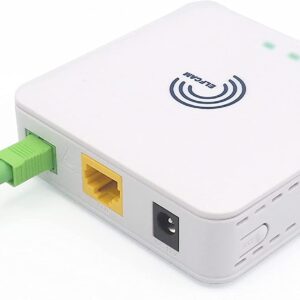
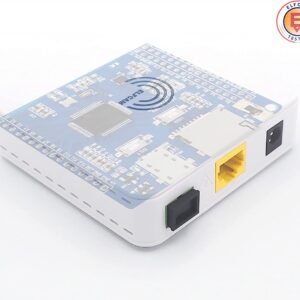
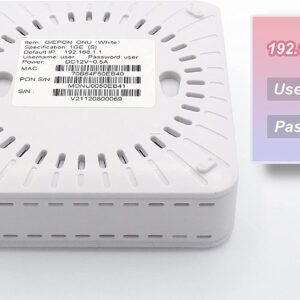
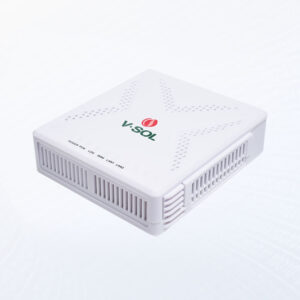
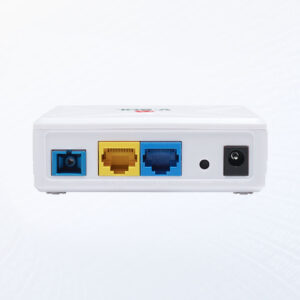
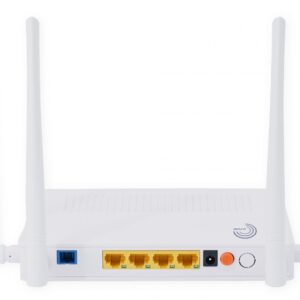
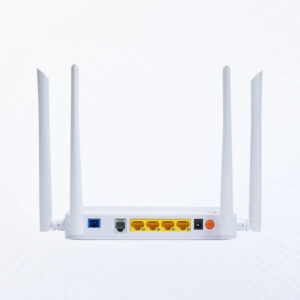
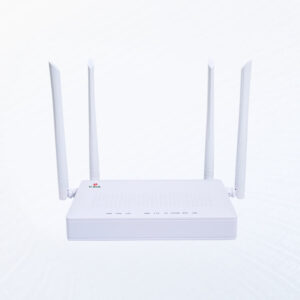
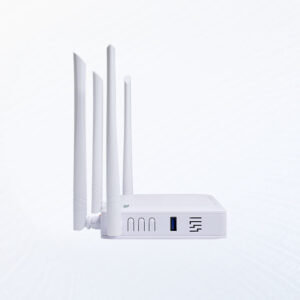
A simple ONU for a single home. It only performs the optical/Ethernet conversion — no routing, no WiFi. The subscriber connects their router behind it. Typical throughput: 1 GE. Used in pure FTTH when the subscriber has their own network equipment.
HGU — Home Gateway Unit
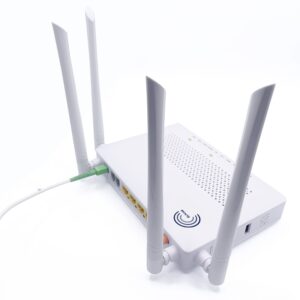
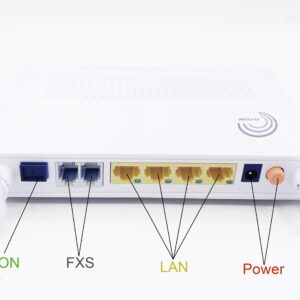
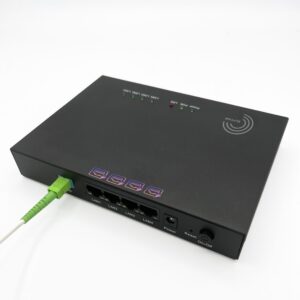
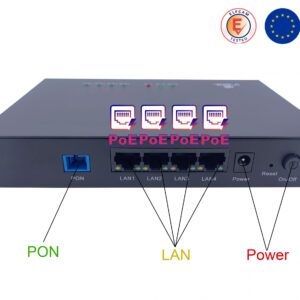
The most common ONU in residential FTTH. It integrates into a single box: ONU, NAT router, DHCPv4/v6 server, WiFi (802.11ac or 802.11ax), VoIP telephone ports (POTS), USB, sometimes CATV. This is what operators call their "box". Examples: Livebox (Orange), Freebox (Free), SFR Box. In a professional environment, a multi-port HGU allows workstations to be connected directly.
MDU — Multi-Dwelling Unit
An ONU for residential buildings or commercial premises. Installed in the technical room, it serves several homes or offices via the existing internal cabling (Ethernet, VDSL2, COAX). An 8 or 16-port MDU can replace 8 or 16 individual ONUs with a single device in the technical cabinet.
SBU / MTU — Small Business / Multi-Tenant Unit
Variants for small businesses and commercial buildings. More advanced routing functions, enterprise QoS, SNMP/TR-069 management interfaces, multiple VLANs. Used in B2B operator FTTx deployments.

GPON, EPON, xPON: which PON technology to choose?
The choice of PON technology determines the available speeds, ONU compatibility, and the upgrade options. Here are the three main ones in active deployment.
GPON (ITU-T G.984)
The dominant standard in Europe and France. Asymmetrical speeds: 2.5 Gbit/s downlink / 1.25 Gbit/s uplink. Sharing ratio up to 1:128. Supports VLAN, QoS (T-CONT classes), the OMCI protocol for ONU management. It is GPON that equips almost all French operator FTTH deployments.
EPON (IEEE 802.3ah)
The dominant standard in Asia (China, Japan, Korea). Symmetrical speeds: 1.25 Gbit/s symmetrical. Native Ethernet architecture, simpler to integrate into campus and SME networks. Management via OAM (IEEE 802.3ah). Less widespread in Europe but used in some private and industrial deployments.
xPON (dual-mode auto-detection)
A hybrid technology that automatically detects whether the OLT opposite is GPON or EPON and adapts. A single xPON ONU can operate equally on both types of OLT. Ideal for integrators managing mixed networks or for resellers who stock a single part number.
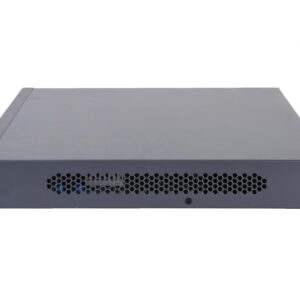
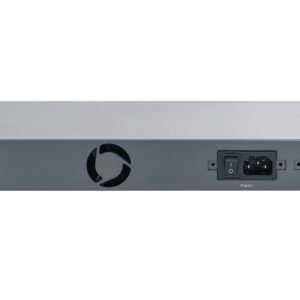
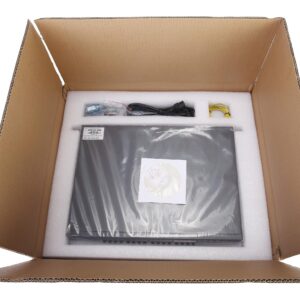
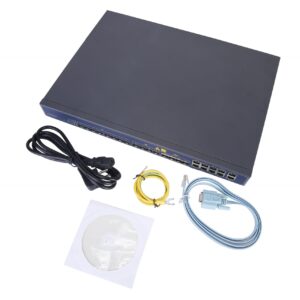
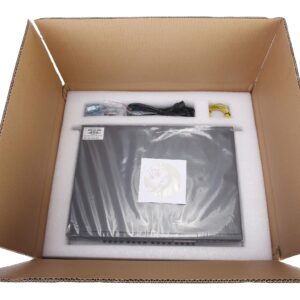
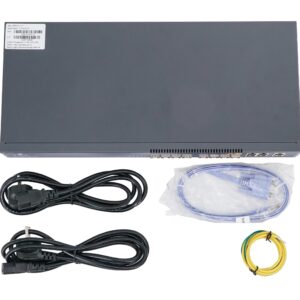
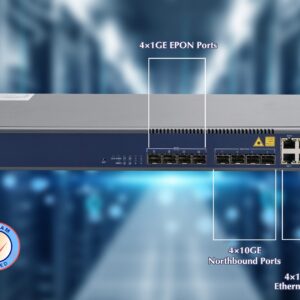
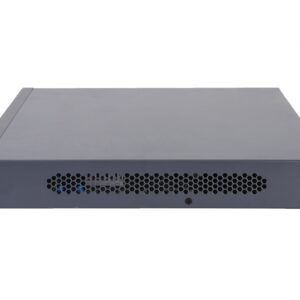
Recommended OLTs for private FTTH deployments
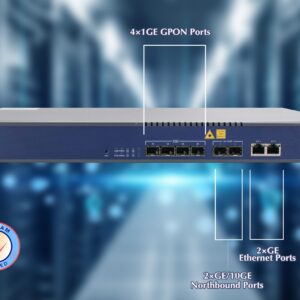
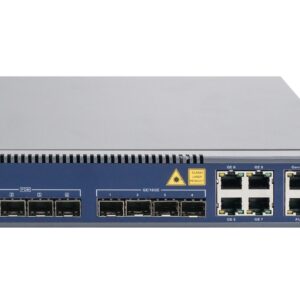
- GPON / EPON OLT — from 4 to 16 PON ports depending on the network size
- SFP OLT Transceiver — for modular chassis OLT

Comparison table of FTTx architectures
| Criterion | FTTH | FTTB | FTTC | FTTdp |
|---|---|---|---|---|
| End of the fibre | Inside the home | Building technical room | Street cabinet | Distribution point (<100m) |
| Last segment | Fibre | Ethernet / coaxial / copper | Copper (VDSL2) | Copper (G.fast / XG-fast) |
| Typical max speed | 1–10 Gbit/s | 100–500 Mbit/s | 20–100 Mbit/s | 200 Mbit/s–1 Gbit/s |
| Latency | < 5 ms | 5–10 ms | 10–20 ms | 5–10 ms |
| Deployment cost | High | Medium | Low | Medium |
| Subscriber equipment | ONU/ONT | Ethernet CPE / VDSL modem | VDSL2 modem | G.fast CPE |
| Preferred use | Residential, enterprise, SME | Buildings >4 floors | Suburban / rural areas | Dense areas, older buildings |
| Scalability | Excellent (XGS-PON 10G) | Limited (internal cabling) | Low | Moderate |
How to choose your FTTx architecture?
The choice of FTTx architecture depends on three main factors: the type of building, the available budget, and the target speeds.
New building or major renovation
FTTH is systematically recommended. The fibre is run during the structural works for a marginal cost. An OLT is installed in the technical room, and each home is equipped with an ONU or ONT. The initial investment is recovered in 3–5 years thanks to the removal of copper cabling and to scalability (moving from GPON → XGS-PON without redoing the passive network).
Existing building with Cat5e/Cat6 Ethernet cabling
FTTB is the most economical solution. The fibre arrives at the technical room, and the existing equipment (Ethernet switch, structured cabling) is reused. An MDU ONU in the technical room is enough to serve the entire building.
Rural or suburban area without infrastructure
FTTC often remains the only short-term option. For isolated new constructions, a reinforced outdoor fibre to the connection point is the most durable solution, with a GPON or xPON ONU as the termination.
SME or commercial building
Prefer an SFU or SBU ONU connected to a 10G switch to serve the workstations. If the building is multi-tenant, an MDU ONU in the technical room simplifies management and reduces the number of interventions.
Installation tip
For private FTTH deployments (campus, hotel, co-ownership), using a GPON or EPON OLT with 1:8 or 1:16 splitters lets you share the feeder fibre and limit the number of cables to run to the private NRO.