Réseaux GPON : architecture, fonctionnement et déploiement FTTH

Sommaire
Le GPON (Gigabit Passive Optical Network) est la technologie sur laquelle repose la quasi-totalité des déploiements FTTH en France et en Europe. Normalisé par l'ITU-T sous la référence G.984, il permet à un seul équipement central de desservir jusqu'à 128 abonnés via un réseau de fibres et de diviseurs passifs. Comprendre son architecture et son fonctionnement est indispensable pour tout professionnel impliqué dans la conception, le déploiement ou la maintenance de réseaux fibre optique.
Définition et normes du GPON
Le GPON est défini par la série de normes ITU-T G.984 (G.984.1 à G.984.6), publiées entre 2003 et 2008. Son nom complet — Gigabit-capable Passive Optical Network — indique deux propriétés fondamentales : des débits de l'ordre du Gigabit, et une infrastructure de distribution entièrement passive (sans alimentation électrique entre le central et l'abonné).
Ses paramètres de transmission principaux :
- Débit descendant (OLT → ONU) : 2,488 Gbps partagés entre tous les abonnés d'un port PON
- Débit montant (ONU → OLT) : 1,244 Gbps partagés
- Longueurs d'onde : 1490 nm descendant / 1310 nm montant (+ 1550 nm pour la télévision analogique CATV optionnel)
- Portée maximale : 20 km entre l'OLT et l'ONU le plus éloigné
- Ratio de split maximal : 1:128 (typiquement 1:32 à 1:64 dans les déploiements réels)
À titre de comparaison, la génération suivante — XGS-PON (G.9807.1) — multiplie par 4 : 10 Gbps symétrique descendant et montant, sur la même infrastructure fibre et les mêmes splitteurs.
Architecture d'un réseau GPON : les 3 segments
Un réseau GPON se décompose en trois segments successifs, chacun avec un rôle et des équipements spécifiques :
Segment 1 — Réseau de transport (Feeder)
La fibre de transport relie l'OLT (Optical Line Terminal), situé dans le NRO (Nœud de Raccordement Optique) de l'opérateur, jusqu'au premier niveau de splitter dans la rue ou l'immeuble. Ce segment utilise typiquement des câbles à haute densité de fibres (48 à 288 fibres) posés en conduit souterrain. La fibre y est précieuse — toute fibre de transport dessert des dizaines d'abonnés en aval.
Segment 2 — Réseau de distribution
Ce segment part des splitteurs de premier niveau (1:4 ou 1:8) jusqu'aux splitteurs de second niveau (1:8 ou 1:16) situés en pied d'immeuble ou dans les boîtiers de rue (PBO). C'est le cœur passif du réseau — aucun équipement actif, uniquement de la fibre et des diviseurs optiques. La maintenance de ce segment est quasi nulle sur 25 à 30 ans.
Segment 3 — Réseau de branchement (Drop)
Ce dernier segment relie le PBO au logement ou local de l'abonné — typiquement une fibre individuelle de 50 à 200 m posée en façade ou en souterrain. Elle aboutit à la PTO (Prise Terminale Optique) murale dans le logement, où l'abonné branche sa jarretière vers l'ONU ou la box opérateur.
Comment fonctionne le GPON : GEM, TDMA et DBA
La particularité technique du GPON réside dans son protocole de transport et sa méthode d'accès au medium partagé. Trois mécanismes sont à comprendre :
GEM (GPON Encapsulation Method)
Le GPON n'utilise pas l'Ethernet natif pour encapsuler les données (contrairement à l'EPON). Il utilise son propre protocole de transport, GEM, qui encapsule toutes les trames Ethernet, IP, VoIP et IPTV dans des trames GEM de taille variable. Chaque flux de service (Internet, voix, télévision) est identifié par un GEM Port-ID unique — ce qui permet une séparation propre des services sans VLAN complexe.
TDMA — Time Division Multiple Access
En sens descendant, l'OLT diffuse en continu à tous les ONU — chaque ONU lit uniquement les trames portant son identifiant (PLOAM). En sens montant, plusieurs ONU partagent la même fibre vers l'OLT : pour éviter les collisions, l'OLT attribue à chaque ONU des créneaux temporels précis (à la microseconde) pendant lesquels il est autorisé à émettre. C'est le principe du TDMA.
DBA — Dynamic Bandwidth Allocation
L'allocation TDMA n'est pas figée : le DBA ajuste dynamiquement la bande passante accordée à chaque ONU en fonction de son trafic en temps réel. Un abonné inactif libère du débit pour un voisin en train de télécharger. Les algorithmes DBA sont définis dans les profils T-CONT (Traffic Container) — chaque T-CONT correspond à un niveau de garantie de service (Best Effort, Committed Information Rate, etc.).
-
Promo !
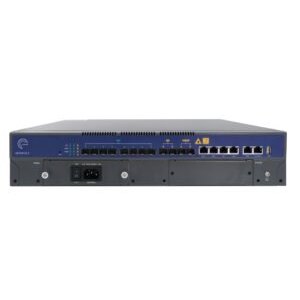
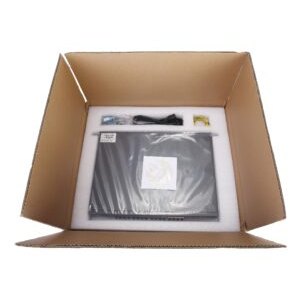
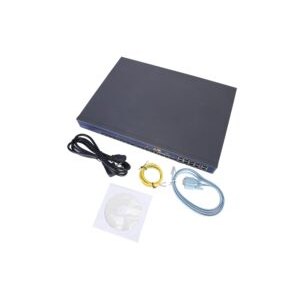
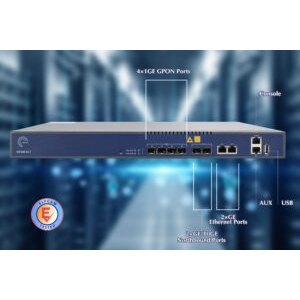
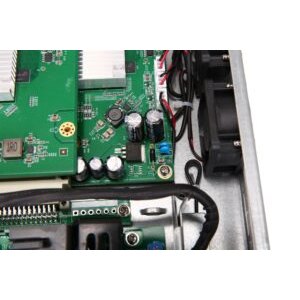
GPON OLT avec 4/8/16 Ports PON, Mettre à Jour Automatique, Gestion Web EMS (8 Ports PON) (Ref:6686)
2 comments Le prix initial était : 799,99 €.699,99 €Le prix actuel est : 699,99 €. + -
Promo !
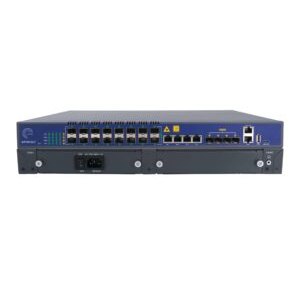
GPON OLT avec 4/8/16 Ports PON, Mettre à Jour Automatique, Gestion Web EMS (16 Ports PON) (Ref:6692)
3 comments Le prix initial était : 1 799,99 €.1 699,99 €Le prix actuel est : 1 699,99 €. + -
Promo !
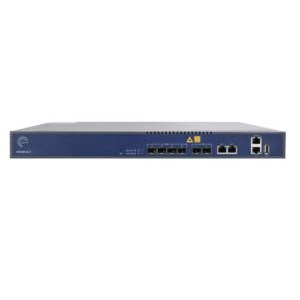
GPON OLT avec 4/8/16 Ports PON, Mettre à Jour Automatique, Gestion Web EMS (4 Ports PON) (Ref:6652)
2 comments Le prix initial était : 1 499,99 €.1 299,99 €Le prix actuel est : 1 299,99 €. +
Sécurité et chiffrement dans les réseaux GPON
Un réseau GPON est un réseau partagé : en sens descendant, toutes les trames émises par l'OLT sont reçues par tous les ONU du même port PON. Sans protection, un ONU malveillant pourrait lire le trafic de ses voisins.
Le GPON intègre deux mécanismes de sécurité :
- Chiffrement AES-128 du trafic descendant — chaque ONU dispose d'une clé AES unique négociée avec l'OLT lors de l'enregistrement. Le trafic d'un abonné est illisible par ses voisins, même s'ils captent physiquement le signal.
- Authentification ONU par numéro de série — chaque ONU possède un Serial Number GPON unique (8 caractères hexadécimaux). L'OLT ne valide que les ONU dont le SN est dans sa liste blanche, empêchant les connexions non autorisées.
Dans les déploiements enterprise, une couche de sécurité supplémentaire est souvent ajoutée via des VLAN par abonné et des règles de filtrage MAC côté OLT — même si un ONU non authentifié parvenait à s'enregistrer, il ne verrait que son propre VLAN isolé.
GPON résidentiel, entreprise et campus
Si le GPON est né pour le FTTH résidentiel, ses qualités — débit élevé, infrastructure passive, longue portée, multi-services — l'ont imposé dans des environnements bien plus larges :
FTTH résidentiel — le cas d'usage originel. Un OLT en central dessert un immeuble ou un quartier complet. Chaque logement dispose d'un ONU ou d'une box intégrant un ONT GPON. Les opérateurs français (Orange, SFR, Bouygues) exploitent des millions de ports GPON.
Réseau d'entreprise et campus — le GPON remplace avantageusement le câblage Ethernet en cuivre pour les grands bâtiments. Un OLT en baie technique centrale dessert des ONU en open-space, salles de réunion et étages via des fibres passives. Zéro switch intermédiaire, zéro alimentation en gaine technique — la maintenance se réduit à une intervention sur le seul OLT.
Hôtellerie et résidences services — le GPON est idéal pour les hôtels et résidences gérées : chaque chambre dispose de son ONU (Internet, téléphonie, IPTV), la gestion centralisée se fait via le logiciel EMS de l'OLT. Consultez notre étude de cas Hotenet pour un exemple concret d'installation hôtelière tout-GPON.
Zones rurales et réseaux d'initiative publique (RIP) — la portée de 20 km du GPON permet de desservir des hameaux éloignés depuis un NRO unique, sans multiplier les équipements actifs intermédiaires.
-
Promo !
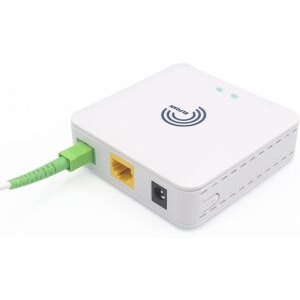
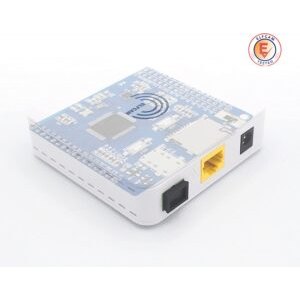
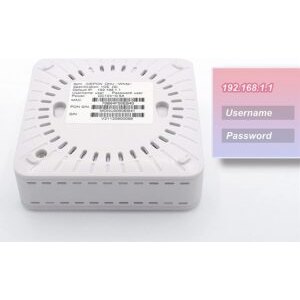
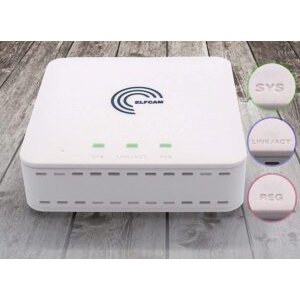
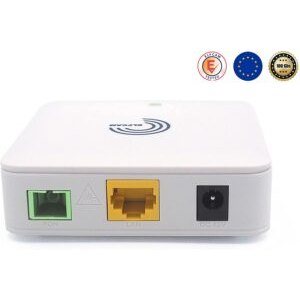
Elfcam – 1GE ONU pour GPON/EPON OLT, avec Port Fibre Optique SC/APC Monomode (Ref:6404)
4 comments Le prix initial était : 59,99 €.49,99 €Le prix actuel est : 49,99 €. + -
Promo !
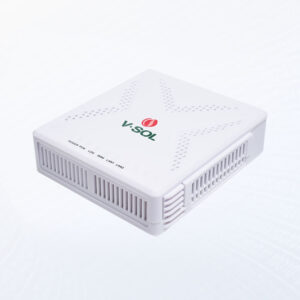
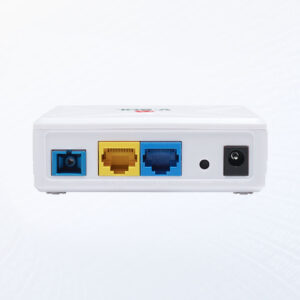
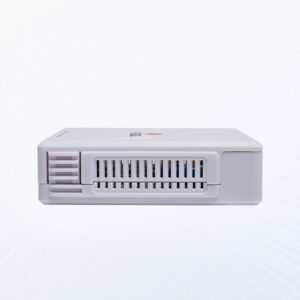
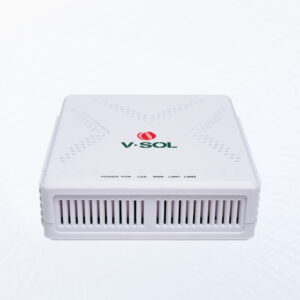
V.SOL – ONU pour GPON/EPON OLT, avec Port Fibre Optique SC/UPC Monomode (1GE + 2,5GbE) (Ref:6965)
2 comments Le prix initial était : 69,99 €.62,99 €Le prix actuel est : 62,99 €. + -
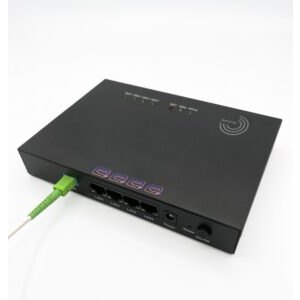
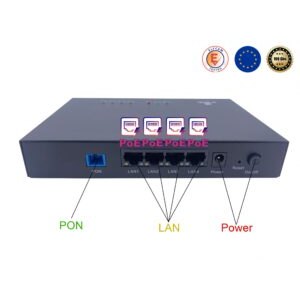
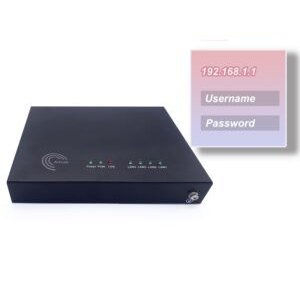
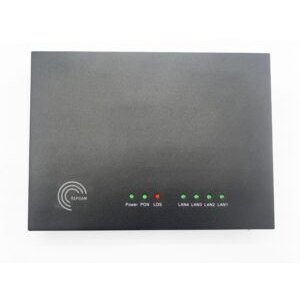
V-SOL 1GE+3FE POE XPON ONU (Ref:7025)
3 comments 99,99 € +
Planifier un déploiement GPON
La conception d'un réseau GPON repose sur quatre paramètres interdépendants :
1. Nombre d'abonnés et ratio de split
Le ratio de split total (produit de tous les niveaux de splitters sur le chemin OLT → ONU) détermine combien d'abonnés partagent un port PON. Un ratio 1:4 × 1:16 = 1:64 est le plus courant en déploiement résidentiel. En dessous de 1:32, chaque abonné dispose d'une bande passante confortable même aux heures de pointe.
2. Budget optique
La somme de toutes les pertes sur le trajet (câble, connecteurs, splitters) doit rester inférieure au budget optique de la classe d'équipement :
- Classe B+ : budget 28 dB — standard pour les déploiements urbains jusqu'à 20 km
- Classe C+ : budget 32 dB — pour les longues distances ou les ratios de split élevés
- Classe C++ : budget 35 dB — pour les déploiements ultra-denses ou les zones rurales étendues
3. Architecture de splitter
Deux approches : split centralisé (splitter unique 1:64 en NRO, fibre dédiée jusqu'à chaque abonné) ou split distribué en cascade (1:4 en NRO + 1:16 en PBO). Le split centralisé simplifie la maintenance mais consomme plus de fibres de transport. Le split distribué optimise l'utilisation des câbles au prix d'une plus grande complexité des nœuds intermédiaires.
4. Capacité de l'OLT et évolutivité
Un OLT de 4 ports PON gère jusqu'à 256 abonnés (ratio 1:64). Prévoyez une marge de 20 à 30 % pour l'extension future, et choisissez un OLT dont les cartes de ligne sont remplaçables pour une migration GPON → XGS-PON sans remplacement du châssis.
Calculer le budget optique d'une liaison GPON
Budget optique = pertes câble (0,35 dB/km × distance) + pertes splitters (3,5 dB par niveau de split, soit ~18 dB pour un 1:64) + pertes connecteurs (0,3 dB × nombre) + marge (3 dB recommandée). Si le total dépasse votre classe d'OLT, passez à la classe supérieure ou réduisez le ratio de split.
Migration GPON vers XGS-PON 10G
Le GPON standard (2,5G/1,25G) atteint ses limites face aux usages cloud intensifs et à la multiplication des appareils connectés. La migration vers le XGS-PON (10G/10G) est en cours chez tous les opérateurs européens.
La bonne nouvelle : XGS-PON et GPON coexistent sur la même infrastructure. Les deux technologies utilisent des longueurs d'onde différentes (1270/1577 nm pour XGS-PON vs 1310/1490 nm pour GPON), ce qui permet de les faire cohabiter via des filtres WDM sur les mêmes câbles et splitteurs. La migration se fait donc ONU par ONU — on remplace l'équipement abonné lors d'une intervention terrain, sans toucher au réseau de distribution passif.
Côté OLT, les équipements modernes supportent des cartes de ligne GPON et XGS-PON dans le même châssis. Un port PON peut même servir simultanément des ONU GPON (anciens abonnés) et des ONU XGS-PON (nouveaux abonnés) avec un OLT COMBO.
-
Promo !
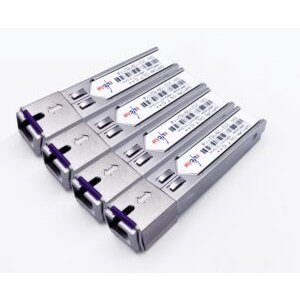
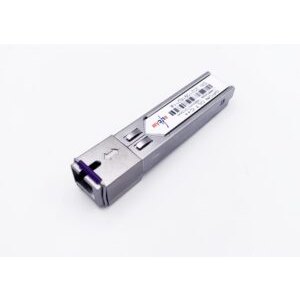
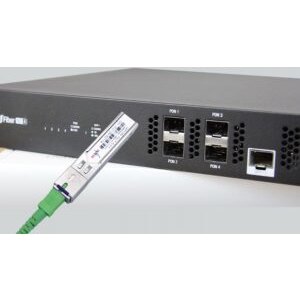
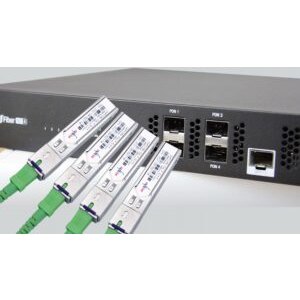
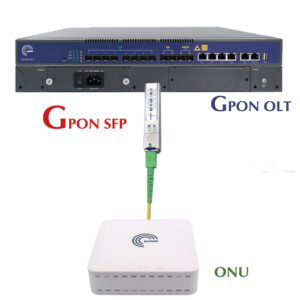
GPON OLT 2,5Gbps SFP Class C++ TX1490nm / RX1310nm 20km Transceiver, 20KM SC/UPC Optical Transceiver (Ref: 6631)
4 comments Lot 1 – Lot 4 Le prix initial était : 79,99 €.71,99 €Le prix actuel est : 71,99 €. + Ce produit a plusieurs variations. Les options peuvent être choisies sur la page du produit -
Promo !
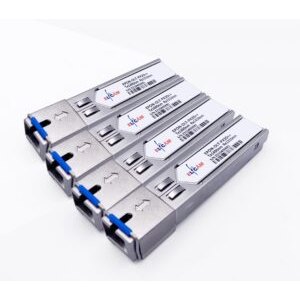
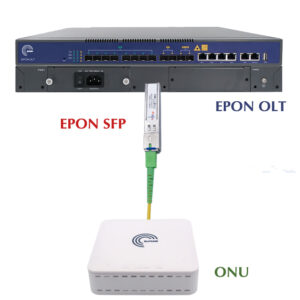
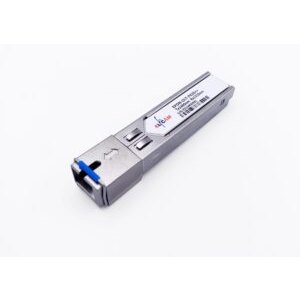
1.25G GPON EPON PX20++ SFP OLT Transceiver, TX1490nm / RX1310nm 20km, SC/UPC Optical Transceiver (Ref:6681)
3 comments Lot 1 – Lot 4 Le prix initial était : 79,99 €.71,99 €Le prix actuel est : 71,99 €. + Ce produit a plusieurs variations. Les options peuvent être choisies sur la page du produit -
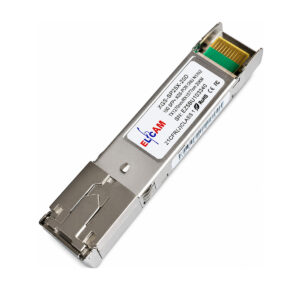
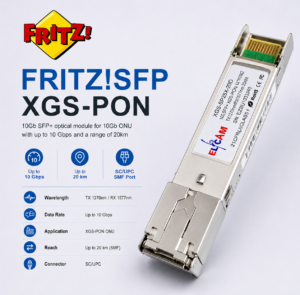
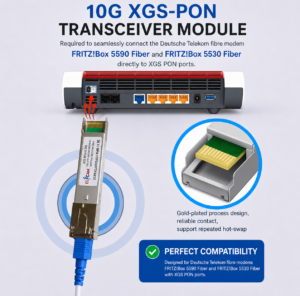
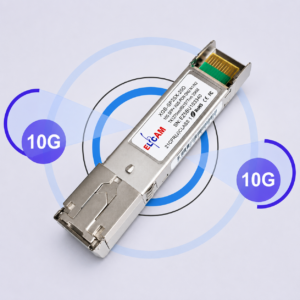
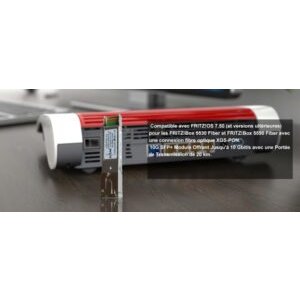
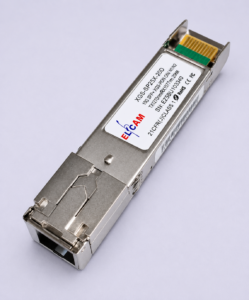
10G SFP+ Optique Module XGS-PON pour 10GbE ONU, Jusqu’à 10 Gbit/s , Compatible avec Les Fritz!Box 5530 Fiber et Fritz!Box 5590 Fiber
3 comments 49,99 € +