Fibres optiques personnalisées : panorama des types par application
Sommaire
Le marché de la fibre optique a longtemps été dominé par un type unique : la monomode G.652 à gradient d'indice, standardisée par l'UIT-T. Ce standard suffisait tant qu'on faisait du transport longue distance en backbone télécoms.
Avec l'explosion des applications — FTTH résidentiel, datacenter haute densité 100G/400G, câbles sous-marins transocéaniques, liaisons WDM étendues — une taille unique ne répond plus à tous les besoins. Cet article passe en revue les principales variantes de fibre optimisées par application.
Chaque application a fait émerger un type de fibre adapté : bend-insensitive pour l'habitat, small-core pour la densité, low-water-peak pour le CWDM, multimode OM5 pour le SWDM datacenter, âme creuse pour la latence ultra-faible.
Pourquoi des fibres personnalisées ?
Les fibres optimisées pour une application spécifique apportent des avantages mesurables :
- Fibres bend-insensitive — indispensables dans les installations intérieures avec angles droits et armoires exiguës
- Gaines fibre rétrécies — augmentent la densité dans un câble multibrins (jusqu'à 3456 fibres dans un câble de 12 mm de diamètre)
- Fibres low-water-peak — permettent le multiplexage CWDM sur 18 longueurs d'onde entre 1270 et 1610 nm
- Fibres très faible atténuation — augmentent l'espacement entre amplificateurs en télécoms longue distance
- Fibres multimodes à gradient d'indice — débits élevés sur courte distance avec émetteurs VCSEL bon marché
G.652 : le standard monomode historique
La recommandation UIT-T G.652 définit la fibre monomode à gradient d'indice utilisée depuis les années 1980. Caractéristiques :
- Diamètre cœur : 8-10 µm
- Diamètre gaine : 125 µm
- Longueur d'onde nominale : 1310 nm (zéro dispersion)
- Atténuation : 0,35 dB/km à 1310 nm, 0,22 dB/km à 1550 nm
Sous-classes :
- G.652.A/B — versions historiques, plus en production
- G.652.C/D — versions low-water-peak actuelles, atténuation minimisée à 1383 nm (bande E)
Fibres Elfcam recommandées par application
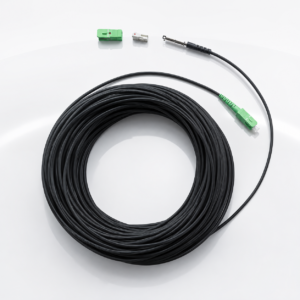
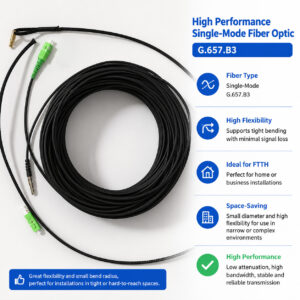
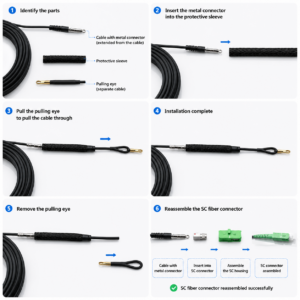
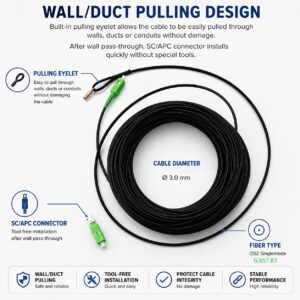
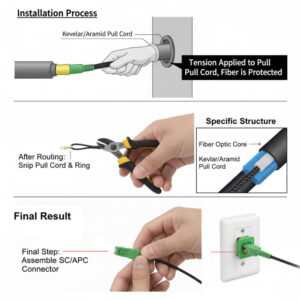
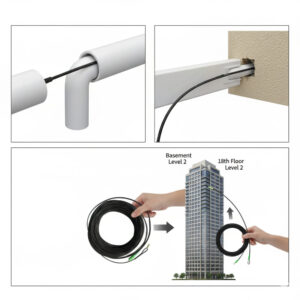
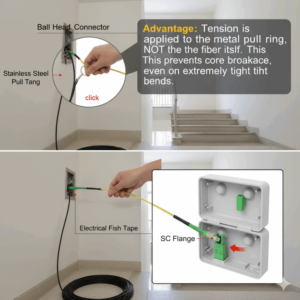
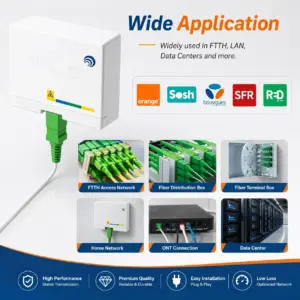
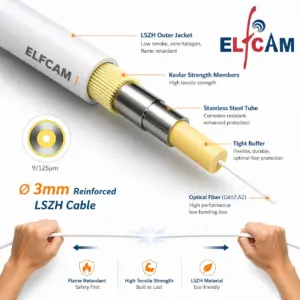
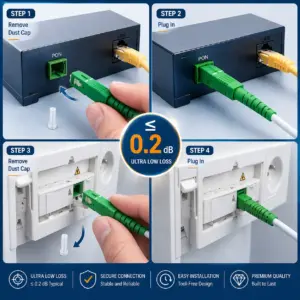
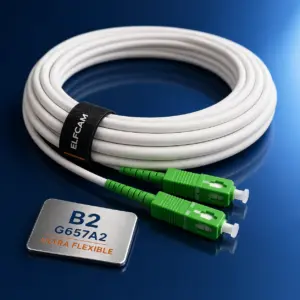
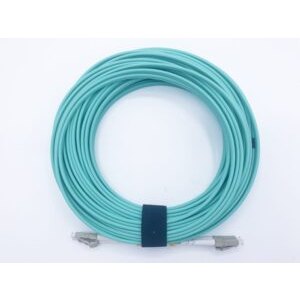
- FTTH domestique — Ref 27261 câble G.657.B3 50 m "Pull-Eye" avec œillet de traction
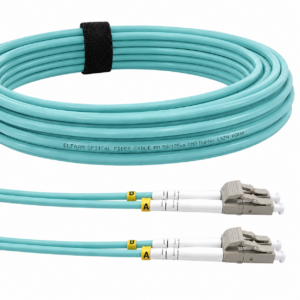
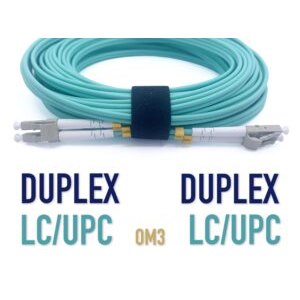
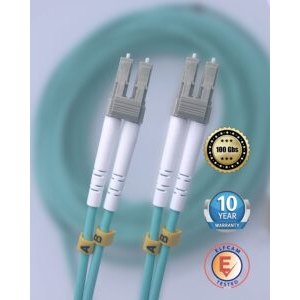
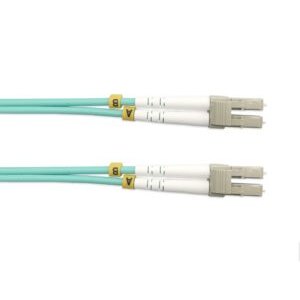
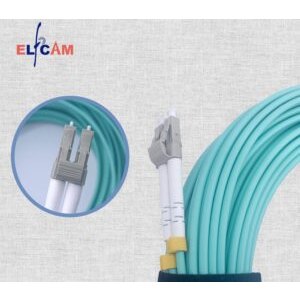
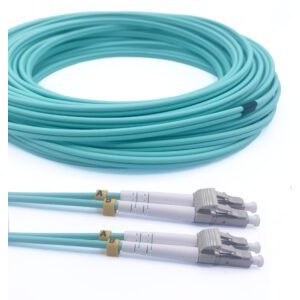
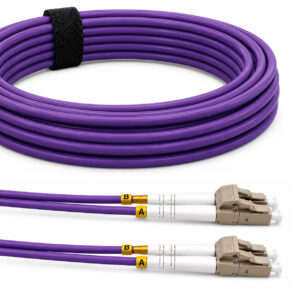
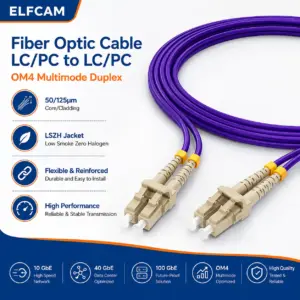
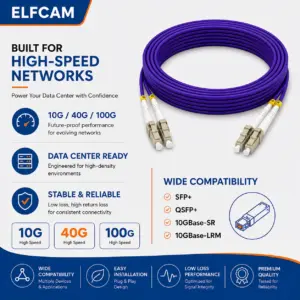
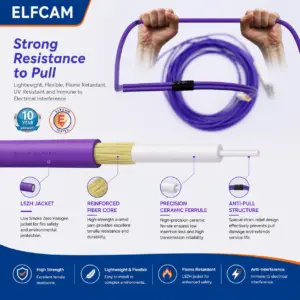
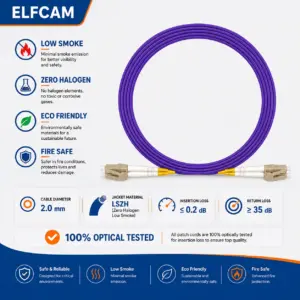
- Datacenter OM3/OM4 — Ref 400 LC/UPC multimode duplex 50/125 µm
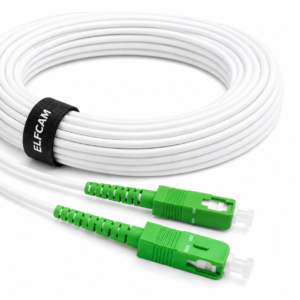
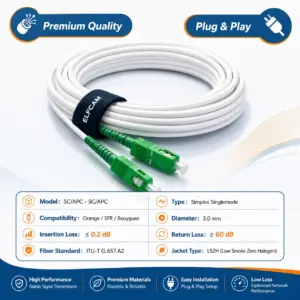
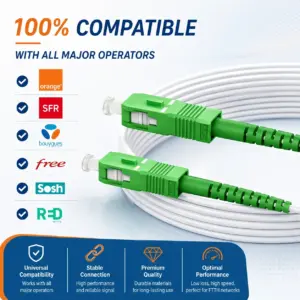
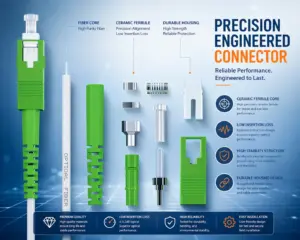
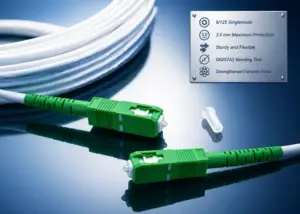
- Backbone monomode — Ref 319 SC/APC blindée renforcée compatible opérateurs FR

Fibres bend-insensitive (G.657)
La norme G.657 définit les fibres résistantes à la flexion, essentielles pour l'accès FTTH en habitat. Deux classes :
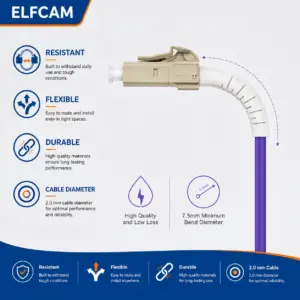
- G.657.A2 — rayon courbure 7,5 mm, compatible 100% G.652
- G.657.B3 — rayon courbure 5 mm, optimisée pour installations serrées
Ces fibres supportent des pliages que la G.652 ne tolérerait pas. Voir notre guide complet sur les fibres résistantes à la flexion.
Fibres de petit diamètre (80/170 µm)
En réduisant la gaine de 125 → 80 µm et le revêtement de 250 → 170 µm, on divise le volume de verre par 2,4. Cela permet d'augmenter la densité de fibres dans un câble :
| Type de fibre | Cœur | Gaine | Revêtement | Application |
|---|---|---|---|---|
| Standard G.652 | 10 µm | 125 µm | 250 µm | Référence télécoms |
| Revêtement fin | 10 µm | 125 µm | 200 µm | Câbles 1728 fibres |
| Gaine réduite | 10 µm | 80 µm | 170 µm | Câbles 3456 fibres |
Les câbles 3456 fibres sont utilisés dans les datacenters hyperscale (Google, Meta, AWS) pour le raccordement inter-bâtiments sur une seule gaine de câble de diamètre modeste.
Fibres à faible pic d'eau (LWPF / G.652.C/D)
Les fibres monomode classiques présentent un pic d'atténuation autour de 1383 nm (bande E), dû aux ions hydroxyle OH⁻ résiduels dans le verre. Les fibres LWPF (Low Water Peak Fiber) éliminent ce pic grâce à des procédés de purification avancés.
Bénéfice : utilisation possible des 18 canaux CWDM entre 1270 et 1610 nm (pas de 20 nm), contre seulement 8-12 canaux sur une fibre standard. C'est essentiel pour les liaisons métropolitaines CWDM et les réseaux FTTH PON étendus.
Fibres multimodes à gradient d'indice (OM3 / OM4 / OM5)
Les fibres multimodes à gradient d'indice de réfraction datent de la fin des années 1960. Elles sont aujourd'hui dédiées aux liaisons courtes haute vitesse (datacenter, campus) avec émetteurs VCSEL (Vertical-Cavity Surface-Emitting Laser) bon marché.
| Type | Bande passante | Portée 10G | Portée 40G/100G | Couleur gaine |
|---|---|---|---|---|
| OM1 (62,5/125) | 200 MHz·km | 26 m | Non supporté | Orange |
| OM2 (50/125) | 500 MHz·km | 82 m | Non supporté | Orange |
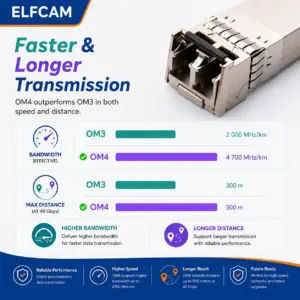
| OM3 (50/125) | 2000 MHz·km | 300 m | 100 m (40G) | Aqua |
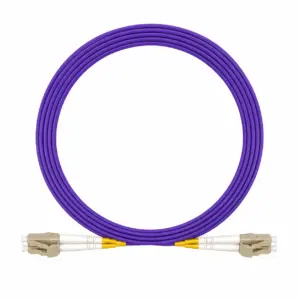
| OM4 (50/125) | 4700 MHz·km | 400 m | 150 m (40G/100G) | Aqua/Violet |
| OM5 (50/125 WBMMF) | 28000 MHz·km | 400 m | 150 m (400G SWDM) | Vert lime |
La norme OM5 (WBMMF, Wide Band Multi-Mode Fiber) est l'évolution récente pour le SWDM (Short Wavelength Division Multiplexing) à 25 Gbit/s sur 4 longueurs d'onde entre 850 et 953 nm. Elle permet aussi le 400G multimode via IEEE P802.3cm.
Quand choisir OM5 plutôt qu'OM4 ?
Si votre datacenter prévoit une migration vers du 400G/800G sur multimode d'ici 2-3 ans, OM5 est plus future-proof. Sinon, OM4 reste amplement suffisant pour 10G/40G/100G avec un coût de 20-30% inférieur.
Fibres à âme creuse microstructurées
Les fibres à âme creuse (HCF, Hollow-Core Fiber) révolutionnent les télécoms en remplaçant le verre par de l'air dans le cœur. La lumière voyage alors à 99,7% de la vitesse dans le vide, contre 67% dans le verre.
Bénéfice concret : −33% de latence par kilomètre. Sur une liaison inter-continentale, gain de plusieurs millisecondes — décisif pour le trading haute fréquence et les applications edge computing.
Lumenisity (racheté par Microsoft en 2022) a démontré en 2021 un câble HCF transmettant 10 Gbit/s en DWDM sur 10 km — une première commerciale. Corning et NKT développent aussi des produits HCF pour datacenter.
FAQ — Fibres optiques personnalisées
1Quelle fibre choisir pour une installation FTTH ?
- Habitat simple, parcours droit → G.657.A2 (rayon 7,5 mm, compatible G.652)
- Moulures, angles droits, armoire exiguë → G.657.B3 (rayon 5 mm)
2OM3, OM4 ou OM5 pour mon datacenter ?
- OM3 — si vous êtes en 10G/25G et ne prévoyez pas d'upgrade 40G+ avant 5 ans
- OM4 — standard actuel pour 10G/40G/100G, excellent compromis coût/portée
- OM5 — si vous avez un roadmap 400G multimode ou des besoins SWDM
3Une fibre LWPF (G.652.D) est-elle compatible avec une G.652.A ?
4Les fibres 80/170 µm sont-elles utilisables en FTTH résidentiel ?
5Quand utiliser une fibre à âme creuse ?
- Trading haute fréquence (HFT) entre places boursières
- Edge computing bas latence
- 5G-URLLC (Ultra-Reliable Low-Latency Communication)
- Liens inter-datacenter critiques
6Peut-on mélanger OM3 et OM4 sur une même liaison ?
7Les fibres OM5 fonctionnent-elles avec les émetteurs OM4 ?
8Où se procurer des fibres spécialisées ?
- G.652 / G.657 / OM3 / OM4 — en stock chez Elfcam, expédition J+1 ouvré
- OM5 WBMMF — sur commande spéciale, 2-4 semaines
- LWPF G.652.D CWDM — sur commande spéciale pour projets opérateurs
- HCF à âme creuse — uniquement via Corning, NKT Photonics ou Microsoft (Lumenisity)
En résumé
La fibre optique n'est plus un produit générique. Chaque application a sa variante optimale : G.657.B3 pour le FTTH, OM4 pour le datacenter courant, OM5 pour le future 400G multimode, LWPF pour le CWDM, petit diamètre pour la haute densité, HCF pour la latence critique.
Consultez notre catalogue câbles fibre optique, modules SFP/SFP+ et adaptateurs pour trouver la solution adaptée à votre projet.