How to Connect Two Fibre Optic Cables — 3 Methods
Contents
Need to extend, repair or join two fibre optic cables? There are three main methods, each with its own advantages and limitations. This article explains when and how to use each one — from fusion splicing (the highest performance) to the mechanical coupler (the simplest, with no specialised tools).
Why join two fibre optic cables?
Common situations that require a joint:
- Extension: the existing cable is too short to reach the equipment
- Repair: a cut or damaged cable, the link must be restored
- Change of connector: switching from SC to LC, or APC to UPC
- Installation: termination of a multi-fibre cable with pigtails
Every joint adds loss to the signal. The goal is always to minimise this loss — that's what differentiates the three methods.
Method 1 — Fusion splicing (maximum performance)
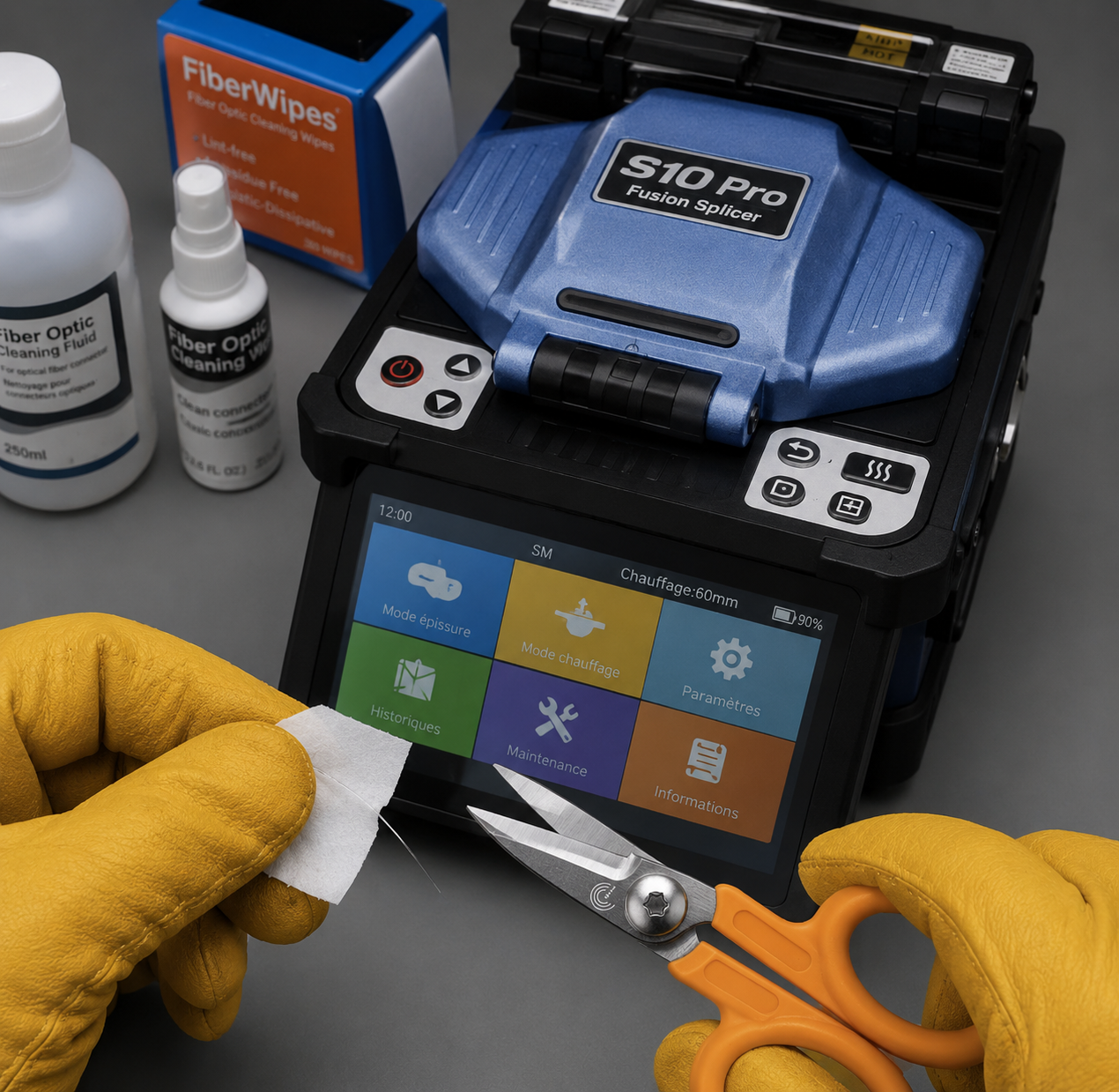
Fusion splicing is the professional standard method. A fibre splicer aligns the two bare fibres under a microscope and then fuses them with an electric arc. The result is a permanent, almost invisible junction, with a loss of only 0.02 to 0.05 dB.
Splicing steps
- Strip: remove the protective jacket over ~3 cm at each end
- Clean: wipe the bare fibre with IPA alcohol
- Cleave: cut the fibre at a right angle with a precision cleaver
- Position: place both fibres in the splicer, which aligns them automatically
- Fuse: the splicer triggers the electric arc and fuses the cores
- Protect: slide on a heat-shrink sleeve and heat it
When to use fusion splicing?
For any permanent installation: FTTH site, network room, patch bay. It's the only acceptable method for long-distance links where every dB counts.
Method 2 — Mechanical coupler (no splicing, plug & play)
The simplest method: join two pre-terminated cables via a coupler (also called an adapter). The coupler aligns the two connector ferrules using a zirconia sleeve.
- Typical loss: 0.2–0.5 dB per joint
- Tool required: none — manual insertion
- Reversible: yes, you can unplug and re-plug
- Connectors: SC↔SC, LC↔LC, SC↔LC (hybrid), FC, ST
Elfcam couplers and pre-terminated cables
- Fibre couplers with zirconia sleeve — SC/APC, LC/UPC, all types
- Pre-terminated fibre cables — SC/APC, LC patch cords, ready to plug in
- FTU kits + cable — fibre extension without splicing
Method 3 — Mechanical splice
The mechanical splice aligns two bare fibres inside a plastic housing filled with index-matching gel. No fusion, no current — just mechanical alignment.
- Typical loss: 0.1–0.5 dB
- Tool required: cleaver + mechanical splice tool
- Advantage: cheaper than a splicer, suitable for emergency repairs
- Drawback: less reliable over time, sensitive to moisture
Comparison table of the 3 joining methods
| Criterion | Fusion splicing | Mechanical coupler | Mechanical splice |
|---|---|---|---|
| Loss | 0.02–0.05 dB | 0.2–0.5 dB | 0.1–0.5 dB |
| Tool | Splicer + cleaver | None | Cleaver + splice tool |
| Tool cost | €€€ (splicer) | Free | € (splice tool) |
| Permanence | Permanent | Reversible | Semi-permanent |
| Reliability | Excellent | Good | Average |
| Speed | 2–5 min / splice | 5 seconds | 5–10 min |
| Ideal for | Permanent installation | Extension, home, testing | Emergency repair |
For splice-free installations
- Elfcam fibre converters — integrated SFP, pack of 2, no splicing required
- Home Fiber guide — complete home fibre network without splicing
- Pigtails — for installations with professional splicing